
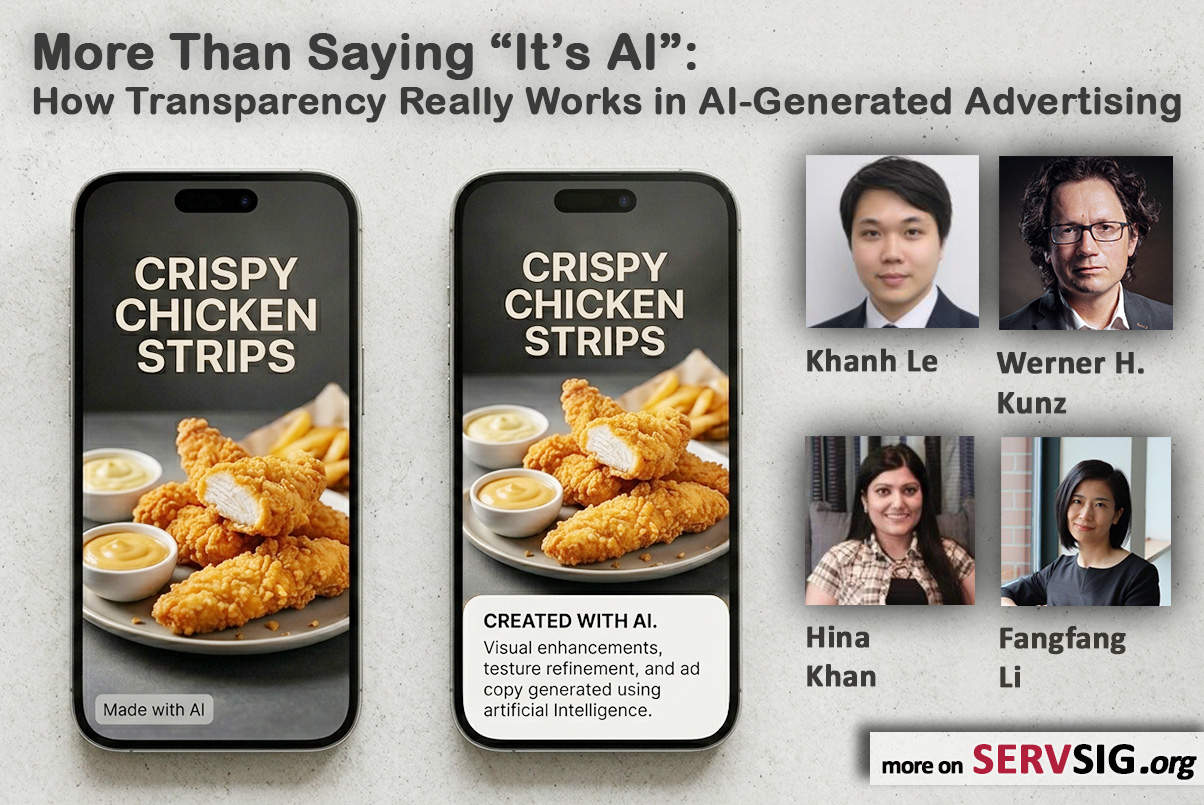
Guest article by Werner H. Kunz, Khanh Bao Quang Le, Hina Khan, and Fangfang Li.
AI advertising expenditure hit about $370 billion in 2022 and is expected to rise to nearly $1.3 trillion by 2032 (Le et al., 2026). Regulators are also adapting: the EU AI Act now requires brands to disclose when their ads are AI-generated. Many companies see this as a compliance requirement and opt for the simplest label. While this reaction is understandable, it also represents a missed chance.
In our new paper in Psychology & Marketing, my co‑authors and I argue that disclosing that you used AI and disclosing how you used it are two very different persuasion games, and only one of them earns you credibility (Le et al., 2026).
AI disclosure transparency – Why “we used AI” is not enough
Despite the surge of spending on AI in advertising, the academic conversation has mostly treated disclosure as a yes‑or‑no switch: the ad is either labeled “AI‑generated” or it is not. That binary framing misses what consumers actually see in the wild. Coca‑Cola’s quiet “Created by Real Magic AI” tag and MANGO published a detailed LinkedIn explanation of how AI shaped its campaign. Both admit AI involvement, yet they tell the viewer wildly different stories about how the work got made. So the real strategic choice is not whether to disclose; it is how clearly to explain AI’s role.
This is where we introduce our central construct, AI role disclosure transparency. That is, the consumer’s subjective sense of how clearly and informatively an ad communicates what AI actually did in the creation process. Two ads can both confess “we used AI” while differing enormously in how transparent that confession feels.

The mechanism – Why clarity changes minds
Our research reveals that when consumers perceive high transparency regarding AI’s role, they tend to trust the ad’s creation process more. This increased trust influences their overall attitude toward the advertisement. We refer to this process as ad creation process credibility, meaning the perception that the methods used to develop the ad are trustworthy and transparent.
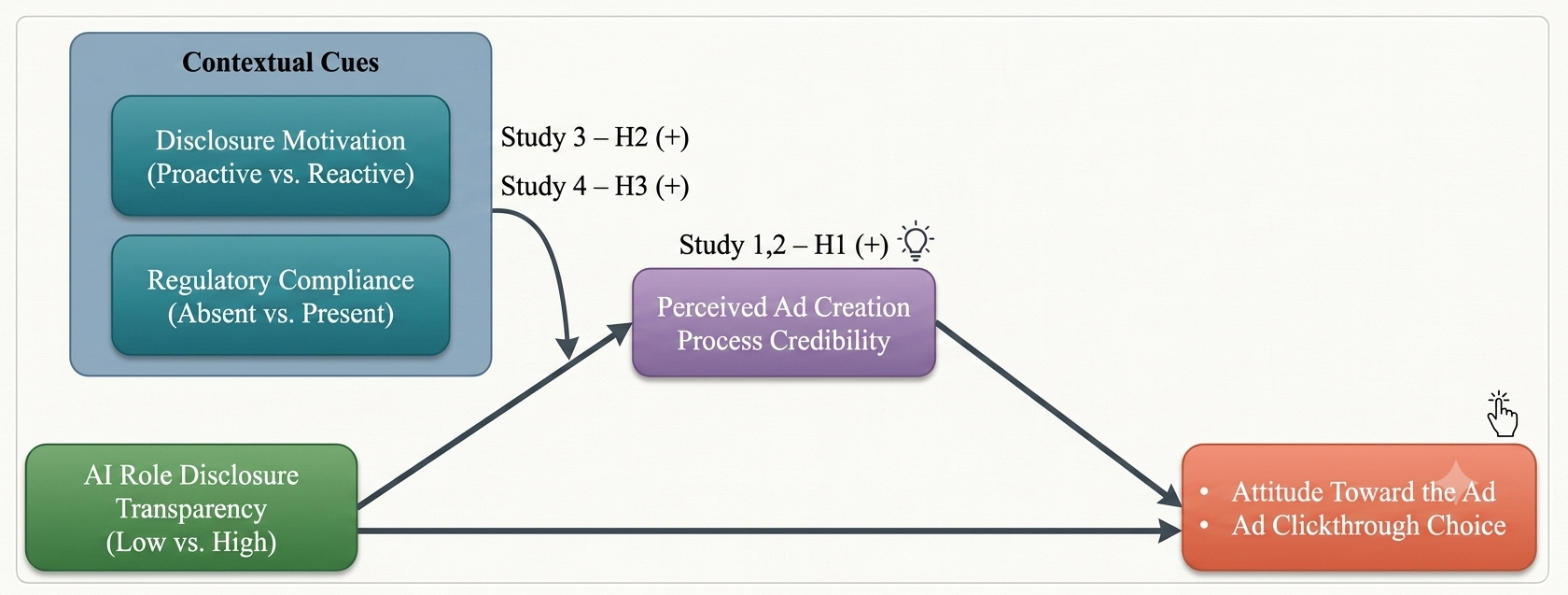
We conducted four experiments involving approximately 1,175 participants. Studies 1 and 2 demonstrated that clearer disclosure of AI’s involvement increased process credibility, which subsequently led to more positive attitudes toward the advertisement.
The direction of attention is worth noting. It is not about who made the ad, nor about what the ad says, but about how it was put together. Studies 1 and 2 established this effect, and we tested it against the usual alternative explanations: perceived authenticity, emotional resonance, creativity, and overall ad quality. None of these carried the result; credibility about the process did.
This corrects a common assumption. Transparency does not work because it makes an advertisement feel more human. It works because it reassures consumers about the machinery they cannot see.
Transparency is not always equally powerful
If the lesson were simply “be transparent,” the studies would not have been necessary. The effect depends heavily on context. We found two conditions that sharpen its effect, and a couple where it goes flat.
The first is the disclosure motive. In Study 3, we presented the same transparent statement in two ways: proactive (“we share this on our own initiative”) and reactive (“we share this in response to public concern”). Transparency mattered more when the motive appeared reactive. A brand that already looks virtuous earns the benefit of the doubt, so the fine print barely registers. A brand that is disclosed under pressure invites scrutiny, and under that scrutiny, the substance of the disclosure begins to do real work.
The second condition is a regulatory compliance signal. In Study 4, half of our participants saw an advertisement bearing a badge indicating it had been assessed under the EU AI Act (Article 50), while the others saw no badge. The cue roughly doubled the credibility effect of transparency and shifted behavior, increasing the likelihood that people clicked “Learn More”. External validation outperforms a brand’s own assurances, because a government-anchored signal frames the disclosure as monitored rather than self-serving.
The honest caveat: frame the disclosure as proactive, or remove the compliance cue, and the credibility gain thins; in the proactive case, it shrank to essentially zero. Transparency is not an ingredient that improves any advertisement. It is a signal, and signals carry meaning only in the right setting.
Managerial implications: disclosure as a design decision
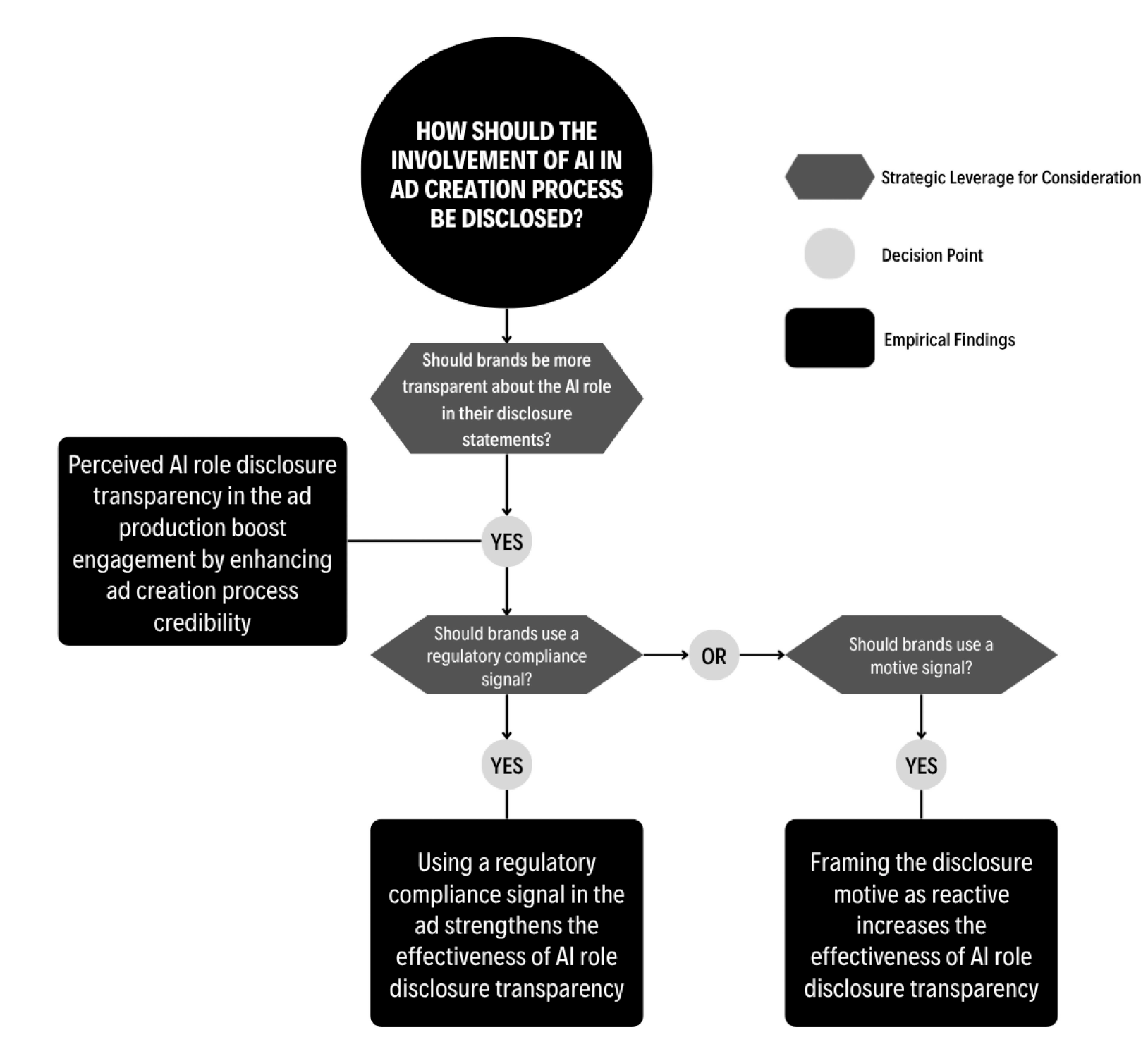
So what should a marketer do? Treat AI disclosure as a design decision, not a disclaimer. We consolidated our key findings into a simple decision-making tree (see below). First, be specific about how AI contributed instead of offering a vague “AI was used here.” Second, read the market: in regulated settings such as the EU, pair your transparent statement with a compliance signal to borrow institutional legitimacy. Third, in unregulated markets where disclosure is voluntary, resist the urge to wrap it in a self‑congratulatory, proactive tone, because that framing can quietly undercut the very credibility you are chasing.
The larger point is a reframing. Disclosure has been filed under “risk mitigation,” a cost to be minimized. Our evidence suggests it can be a lever for persuasion and a source of competitive advantage, provided firms stop asking only whether to admit AI and start asking how clearly, and in what context, to explain it. Saying “it’s AI” is the floor. Showing your work is where the trust, and the clicks, actually come from.
These results open questions worth pursuing. How much detail is “enough” before transparency tips into information overload? Does the reactive-motive advantage survive once disclosure badges become commonplace and consumers stop noticing them? And how do these effects hold in service contexts, where the offering is an experience rather than a finished advertisement?
For more details, see the full paper by Le, Khan, Li, and Kunz (2026) in Psychology & Marketing. If you work on AI disclosure, governance, or advertising effectiveness, we would be glad to hear from you.

Werner Kunz
Professor of Marketing – University of Massachusetts Boston
Director of the digital media lab
Khanh Le
Lecturer in Marketing
Auckland University of Technology, Auckland, New Zealand
Hina Khan
Director of International Teaching Partnerships Engagement
Lancaster University Management School
Fangfang Li
Assistant Professor in Marketing
Leeds University Business School
Reference
Le, K. B. Q., Khan, H., Li, F., & Kunz, W. H. (2026). More than saying “it’s AI”: How role disclosure transparency in AI‑generated ads influences persuasion. Psychology & Marketing, 1–20. https://doi.org/10.1002/mar.70175
