
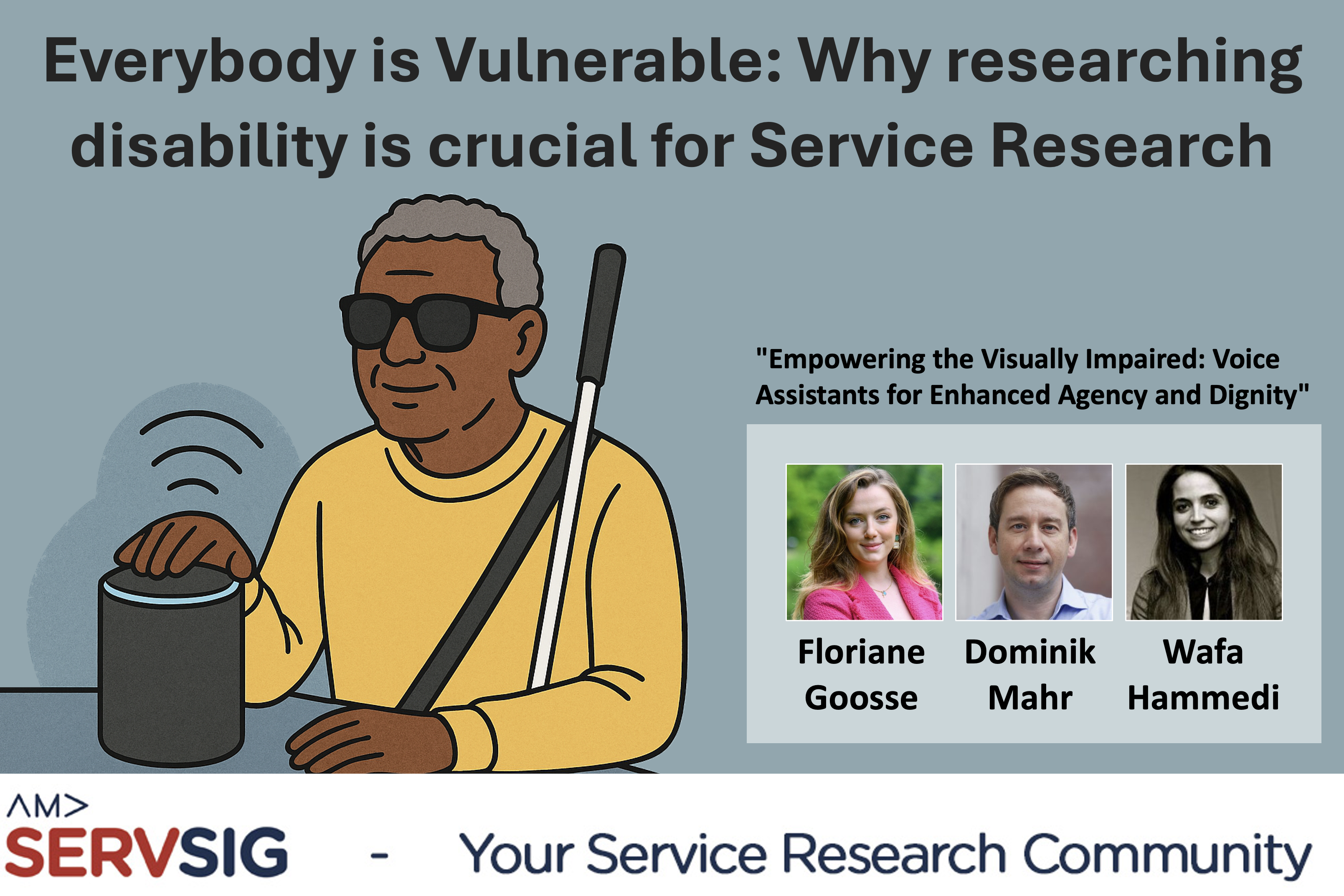
Guest article by Floriane Goosse, Dominik Mahr, and Wafa Hammedi — winners of the 2024 AMA-SERSVSIG Conference Best Paper Award and the QUIS 2025 Best Paper with Social Impact Award for their paper Empowering the Visually Impaired: Voice Assistants for Enhanced Agency and Dignity.
Researching people in situations of vulnerability offers an opportunity to rethink what consumer and service research can – and should – be. By shifting our focus beyond the “average” consumer, we uncover experiences that often remain invisible yet reveal critical frictions in services, technologies, and market systems.
Consider, for instance, a train passenger with visual impairments struggling to purchase a ticket on a national railway website, where essential information is buried deep within difficult-to-navigate menus. Examining such experiences helps us design more inclusive services, online platforms, and mobile apps that ultimately improve usability for everyone. In this example, a ticketing site with clear buttons, voice support, and easy-to-find information would not only support users with visual constraints but also make the process smoother for all customers. This is one of the key reasons why research on vulnerability matters: it helps us see situations from different perspectives and question our assumptions, leading to fairer and more accessible solutions.
Importantly, vulnerability is not a fixed trait. Recent research adopts a situational perspective, recognizing that anyone can become vulnerable depending on the context, environment, or system they are navigating. Vulnerability stems from circumstances, not individuals. And disability does not automatically equal vulnerability, yet many services are designed for only one type of user. When systems fail to accommodate diverse needs, they create vulnerability. This is precisely why research is essential: it helps uncover invisible barriers and supports the design of services that truly work for everyone.
Working with people with disabilities required more than adapting our methods: it required a shift in research mindset.Instead of focusing on limitations, we learned to listen closely and adopt a strengths-based perspective: paying attention to people’s abilities, resources, and aspirations, and recognizing them as experts in their own experiences. This approach revealed powerful insights into agency, creativity, and everyday adaptation. Compared with other research, the fieldwork often took longer and required greater flexibility, but it led to a deeper understanding and very meaningful outcomes. By collaborating with NGOs that support people with visual impairments, we joined workshops, met their members, and shared conversations and experiences that helped us see services through their eyes.
Practical approaches, such as in-depth interviews, participant observation, and co-design workshops, work especially well when researching consumers in vulnerable situations. They help build trust, reveal how people actually interact with services, and give participants a real voice in shaping the research. Simple steps, such as using accessible materials, prototyping, adapting interview formats, and staying open to feedback, make the process more inclusive, respectful, and meaningful for everyone involved.
Importantly, this type of research is not a solo endeavour. Co-creation with participants, and with the wider ecosystem around them, including family members, caregivers, technology providers, policymakers, and the research team, plays a central role. In practice, with many forms: participatory workshops, advisory panels of people with lived experience, or collaborative idea-generation sessions. These approaches give stakeholders a direct voice in the project and help ensure that research questions, methods, and outcomes remain relevant, useful, and grounded in real experiences.
A word of caution: when researching disability, it is especially important to remain reflective and maintain a thoughtful professional distance. Conversations may include painful stories – such as a father who became blind and tetraplegic after an accident – as well as uplifting ones, like a man who lost his sight but found new purpose by teaching others to use AI voice tools in daily life. Holding this balance helps researchers remain fair and respectful while developing genuine empathy. It also enables the uncovering of sensitive insights into dignity, resilience, and everyday coping.
In the end, researching consumers with disabilities is not about studying exceptions. It is about using their experiences as a lens to rethink services, technologies, and research practices in ways that are more inclusive, reflexive, and human.
We are passionate about this research and warmly welcome anyone interested to get in touch and share their experiences.

Floriane Goosse
PhD Researcher in Service & Marketing
University of Namur, Belgium

Dominik Mahr
Professor of Digital Innovation & Marketing,
DEXLab and Maastricht Center for Robots, Maastricht University, The Netherlands.

Wafa Hammedi
Professor of Service Management and Marketing
University of Namur, Belgium
Selected Sources:
– Goodley, D. (2024). Disability Studies: An Interdisciplinary Introduction. SAGE Publication
– Hammedi, W., Parkinson, J., & Patrício, L. (2023). SDG commentary: services that enable well-being of the human species. Journal of Services Marketing, 38(2), 153–163. https://doi.org/10.1108/jsm-09-2023-0324
– Henkens, B., Schultz, C. D., De Keyser, A., & Mahr, D. (2025). The sound of progress: AI voice agents in service. Journal of Service Management, 37(1), 1–32. https://doi.org/10.1108/josm-06-2025-0269
– Mende, M., Bradford, T. W., Roggeveen, A. L., Scott, M. L., & Zavala, M. (2024). Consumer vulnerability dynamics and marketing : Conceptual foundations and future research opportunities. Journal Of The Academy Of Marketing Science, 52(5), 1301‑1322. https://doi.org/10.1007/s11747-024-01039-4
– Raciti, M. M., Russell-Bennett, R., & Letheren, K. (2022). A strengths-based approach to eliciting deep insights from social marketing customers experiencing vulnerability. Journal of Marketing Management, 38(11–12), 1137–1177. https://doi.org/10.1080/0267257x.2022.2092196
