
guest article by Laszlo Sajtos, Nayonika Rachakonda, Khanh Bao Quang Le, and Werner H. Kunz
Imagine a hotel receptionist working alongside an AI assistant. The assistant handles routine enquiries, but a guest’s request requires human judgement. Can the receptionist see what the AI has already said? Is it clear when and how to take over? Does the employee have the authority to change the proposed solution?
These everyday questions reveal how much human–AI collaboration depends on the workplace surrounding the technology. Even a capable AI system can be difficult to work with when information is hard to interpret, handovers are unpredictable, or responsibilities are unclear.
In our article, “The future workplace: developing the human-machine symbioscape,” published in the Journal of Service Management, we explore how organisations can design environments that support collaboration between people and intelligent machines.
Service researchers have long recognised that environments shape behaviour and experience. The servicescape provides a powerful foundation for understanding these influences. We extend this thinking to the shared work environment of humans and AI, introducing the concept of the human-machine symbioscape. Drawing inspiration from biological symbiosis, the concept directs attention to the conditions that allow different actors to work and adapt together.
The symbioscape comprises three interconnected layers (see Figure). The first, physical–digital conditions, concerns what people and machines can access and perceive. For our receptionist, this might mean a shared display showing the conversation so far, unresolved issues, and the system’s current status. These features help make the need for intervention apparent.
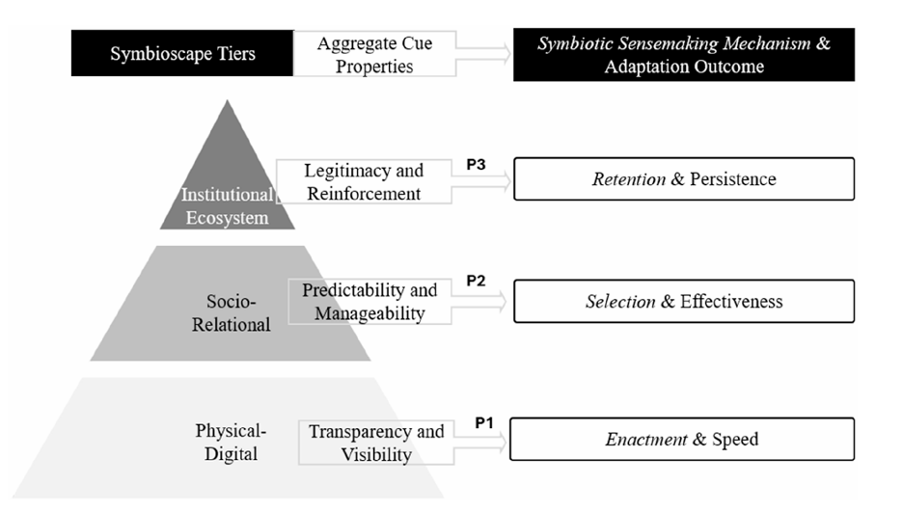
The second, socio-relational conditions, concerns how collaboration unfolds. A visible problem still needs a manageable response: clear handover arrangements, predictable escalation procedures, and notifications that help employees prioritise without overwhelming them.
The third, institutional–ecosystem conditions, concerns the rules and support that sustain collaboration. Employees need to understand their decision rights, who is accountable, and how to handle exceptions. Training and opportunities to learn from difficult encounters help successful adjustments become part of everyday practice.
Our conceptual framework proposes that these environmental conditions shape how quickly human–AI teams adapt, how effectively they coordinate, and whether improved ways of working persist. The layers also depend on one another. A well-designed interface has limited value if employees lack the authority to act on what it reveals.
For service managers, this offers a practical starting point: examine whether employees can understand machine activity, coordinate their responses, and draw on clear organisational support. For researchers, it raises questions about why similar technologies produce different collaborative outcomes across workplaces, and how environmental design affects employee discretion, workload, and learning.
The future of human–AI collaboration will depend partly on the environments we create around it. Designing those environments is an opportunity for service research to help shape how people and intelligent machines work together.

Laszlo Sajtos
Professor of Marketing
University of Auckland Business School
Nayonika Rachakonda
University of Auckland
Khanh Le
Lecturer in Marketing
Auckland University of Technology, Auckland, New Zealand
Werner Kunz
Professor of Marketing – University of Massachusetts Boston
Director of the digital media lab
Reference:
Sajtos L, Le KBQ, Rachakonda N, Kunz WH (2026;), “The future workplace: developing the human-machine symbioscape”. Journal of Service Management, Vol. ahead-of-print No. ahead-of-print. https://doi.org/10.1108/JOSM-11-2025-0643
Read the open-access article in the Journal of Service Management.
