
Guest article by Dominik Mahr and Wafa Hammedi.
AI is everywhere in our research conversations—but what about our teaching?
Most of us scholars spend a large part of our academic lives teaching, designing courses, interacting with students, and preparing the next generation of service professionals. And just as generative AI is transforming research and practice, it is rapidly entering this part of our work. Students are already using AI—often extensively, perhaps too much. Educators are experimenting with it, some cautiously, some enthusiastically. Universities are developing policies and infrastructures, although at very different speeds. At the same time, enthusiasm about what AI could make possible sits alongside serious concerns about critical thinking, academic integrity, overreliance, and even the future role of the educator.
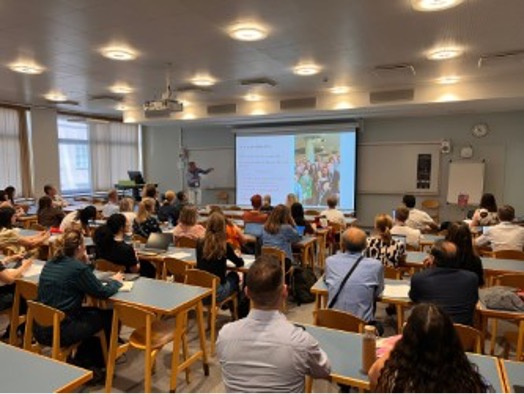
At the wonderful Frontiers in Service Conference 2026 in Helsinki, we deliberately created a special session around a topic that sometimes receives less attention at research conferences: education. Rather than another discussion about whether AI is “good” or “bad” for education, our session—“AI for Teaching: Rethinking How We Educate Future Service Managers in the Age of AI”—started from a different question: How can we use AI to create better learning, and what can we learn from each other as a service community? The session was intended as an appetizer: bringing together initial evidence, concrete experiences, and—most importantly—the community, to start a conversation in which people share ideas and take new ones home.
AI has arrived in service education
To take the pulse of the community, we conducted a survey among SERVSIG members. With a small sample, it’s not representative, but the results offer an interesting snapshot.
Half of the respondents (n=28) use AI tools daily, with another 21% using them several times a week. AI is already used for preparing course materials (82%), designing slides (75%), creating assignments (71%), supporting classroom interaction (54%), and administrative tasks (50%).
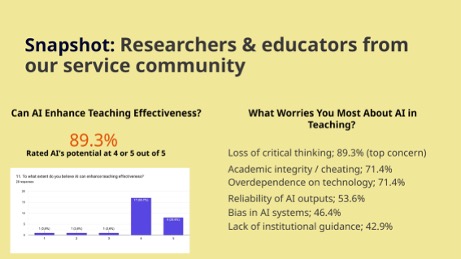
Perhaps more revealing is the tension behind these numbers 89% rated AI’s potential for enhancing teaching effectiveness at four or five out of five. Yet exactly the same share identified loss of critical thinking as a major concern. Academic integrity/cheating and overdependence on technology followed, both at 71%.
The discussion echoed this critical-thinking concern. If students can obtain a polished answer instantly—and sometimes one that appears stronger than what they could produce themselves—what exactly should we be teaching and assessing? As one participant put it, educators increasingly need to reconsider what their distinctive contribution is when students perceive AI as capable of explaining material very well.
Four inspirations from our community: from AI efficiency to AI-enabled learning
Four of our most passionate colleagues from the SERVSIG community then opened the door to their classrooms and shared how they are already rethinking teaching with AI. They showed how it can be used to create richer learning experiences: giving students more opportunities to practice, introducing productive friction that challenges them to think more deeply, and encouraging reflection on both the process and the quality of their own learning. What made these examples especially compelling is that they highlighted AI not as a replacement for good teaching, but as a tool that can help us design learning experiences that would otherwise be difficult to offer at scale.
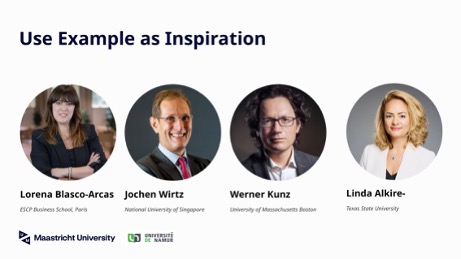
Productive friction. Lorena Blasco-Arcas (ESCP Business School) challenged the idea that technology should always make learning frictionless. In her social media course, students interact with AI-powered virtual clients who can be demanding, reluctant to provide information, and difficult to convince. The objective is not to make the task easier but to create productive friction. Students must question, interpret, make judgments, and subsequently receive coaching. As Lorena summarized it, students should become skilled at “thinking with the tools, not letting the tools think for them.”
Experiential learning at scale. Jochen Wirtz (National University of Singapore) showed how AI agents can expand experiential learning in MBA education. In corporate finance, students can interrogate AI agents representing the CEO, CFO, CMO, and other executives around a complex IPO. Students can repeatedly practice situations that would previously have been extremely difficult to create at scale. His experience also highlighted another requirement: faculty need support. Training professors to build agents was followed by individualized tutoring to help them translate ideas into teaching applications.
Transparency instead of policing. Werner Kunz (University of Massachusetts Boston) approached one of the biggest concerns from another direction: rather than trying to police whether students use AI, he makes their AI use part of the learning process. His assignments are accompanied by an AI Use and Reflection Form: Which tools did you use? What was your first prompt and your last? How did you verify the output? And, crucially, what did you learn? This creates transparency while also generating information for educators about how students actually work with AI.
Practice with instant feedback. Finally, Linda Alkire (Texas State University) showed how AI simulations can scale learning in professional selling. Students repeatedly practice sales conversations, discovery calls, presentations, objection handling, pitches, and even job interviews with AI-powered partners. They receive immediate feedback on content as well as delivery—including speaking pace and sentence length—before bringing their learning back into the classroom. This changes the professor’s role: from repeatedly evaluating practice to coaching students on how to improve it.
Our sincere thanks to Lorena, Jochen, Werner, and Linda for sharing their experience and tips so openly, and to everyone who joined the session and enriched the discussion.
From islands to bridges
The examples were deliberately different. There is no single “best” AI teaching practice—and that may be precisely the point. What works depends on learning objectives, students, institutional context, resources, and pedagogical philosophy.
But one message stood out: experimentation by individual educators is not enough.
Across universities, many excellent initiatives remain “islands.” We need bridges between them—and we need to learn from each other. Building those bridges goes far beyond buying AI licenses. It includes strategy, governance, infrastructure, accessibility, AI literacy, faculty development, assessment, curriculum design, research, and responsible use.
The survey also shows how many such islands already exist. We used it to explore how members of the SERVSIG community are currently using AI in their teaching and to identify practices worth sharing further. These applications can be broadly divided into two categories: core pedagogical practices and emerging advanced practices.
| Core pedagogical practices | Emerging advanced practices |
| Assessment Design & Correction Designing quizzes, refining question wording, and streamlining correction workflows. | Data Analysis & Dataset Creation Creating realistic social media datasets and client profiles; supporting students with statistical analysis via AI agents. |
| Course Design & Teaching Materials Creating slides, videos, flashcards, and mind maps; using NotebookLM to synthesize readings. | AI Agents & Personalized Tutoring Deploying AI as a thesis coach, startup advisor, or assignment companion to tailor the learning journey. |
| Case Development & Experiential Learning Building self-developed cases and simulations to reduce reliance on HBR cases; customer profiles for design exercises. | Role-Play, Interviews & Negotiation Simulating interviews and negotiations with bots; interaction logs as research data on algorithm aversion. |
| Creativity & Student Engagement Designing games, discussion prompts, and activities that go beyond the book instructor’s knowledge base. | Immersive Simulations & VR Skills Training Using AI-enabled VR for soft skills, thesis defense practice, interviewing, and intercultural communication simulations. |
Let’s build this together
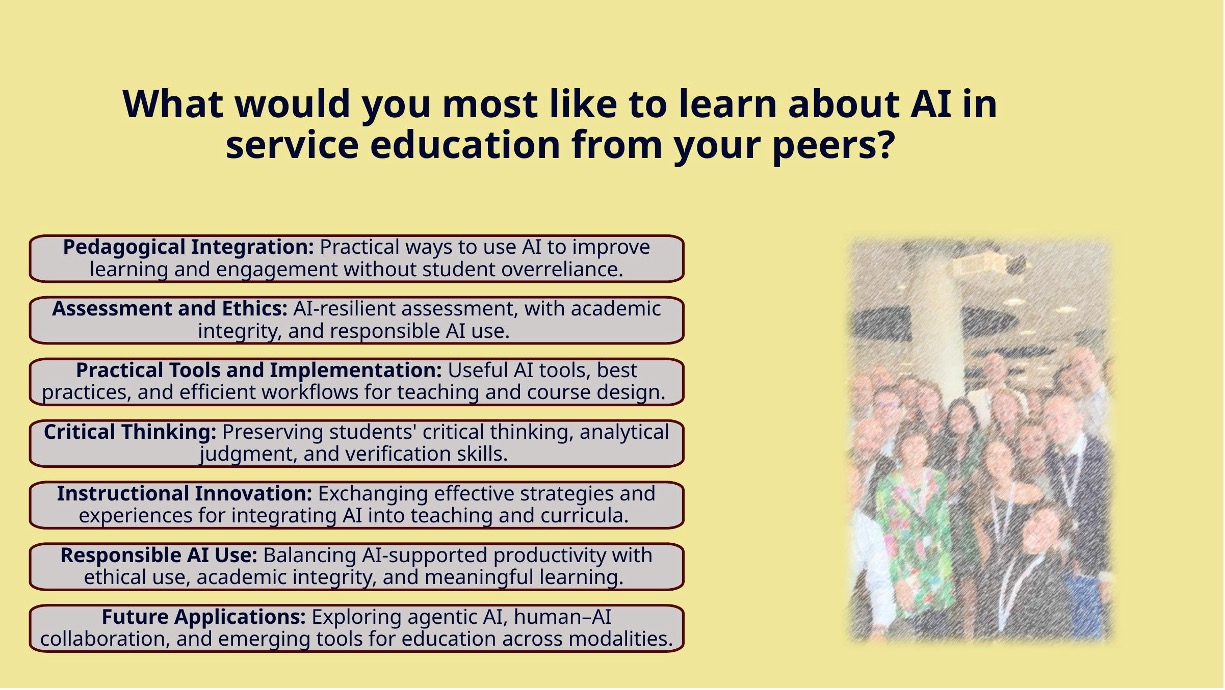
When we asked what SERVSIG members wanted to learn from peers, several themes repeatedly surfaced: pedagogical integration, AI-resilient assessment, practical tools, maintaining critical thinking, responsible AI, instructional innovation, and emerging applications such as agents and human–AI collaboration.
The closing discussion led to a simple idea: let’s not solve all of this independently.
Could we create a shared collection of service-specific AI teaching tools and examples? Could members contribute one exercise, agent, simulation, reflection format, or lesson learned? Could we periodically meet online to show one application and openly discuss what worked—and what did not?
So, this is also a call to the SERVSIG community: What are you doing with AI in your teaching? What can others learn from it? What failed? And what would you like to learn from others?
This exchange can take many forms, and several are already taking shape. These include the AI4Educators online seminar series by SERVSIG, ongoing conversations on LinkedIn, and special sessions at upcoming conferences. Other formats will follow as we learn more about what creates the most value for our community.
The ambition is not simply to talk about AI, but to create a space where educators can openly share what they are trying, what is working, what is not, and what they are still figuring out. If you have an example from your own teaching, a question you would like the community to explore, or an idea for a future session, we would love to hear from you.
Join the conversation, share your experience, and help other educators to shape what comes next.
