
Guest article from Ming-Hui Huang, Christopher Lovelock Career Contributions to the Service Disciple Award Recipient 2026.
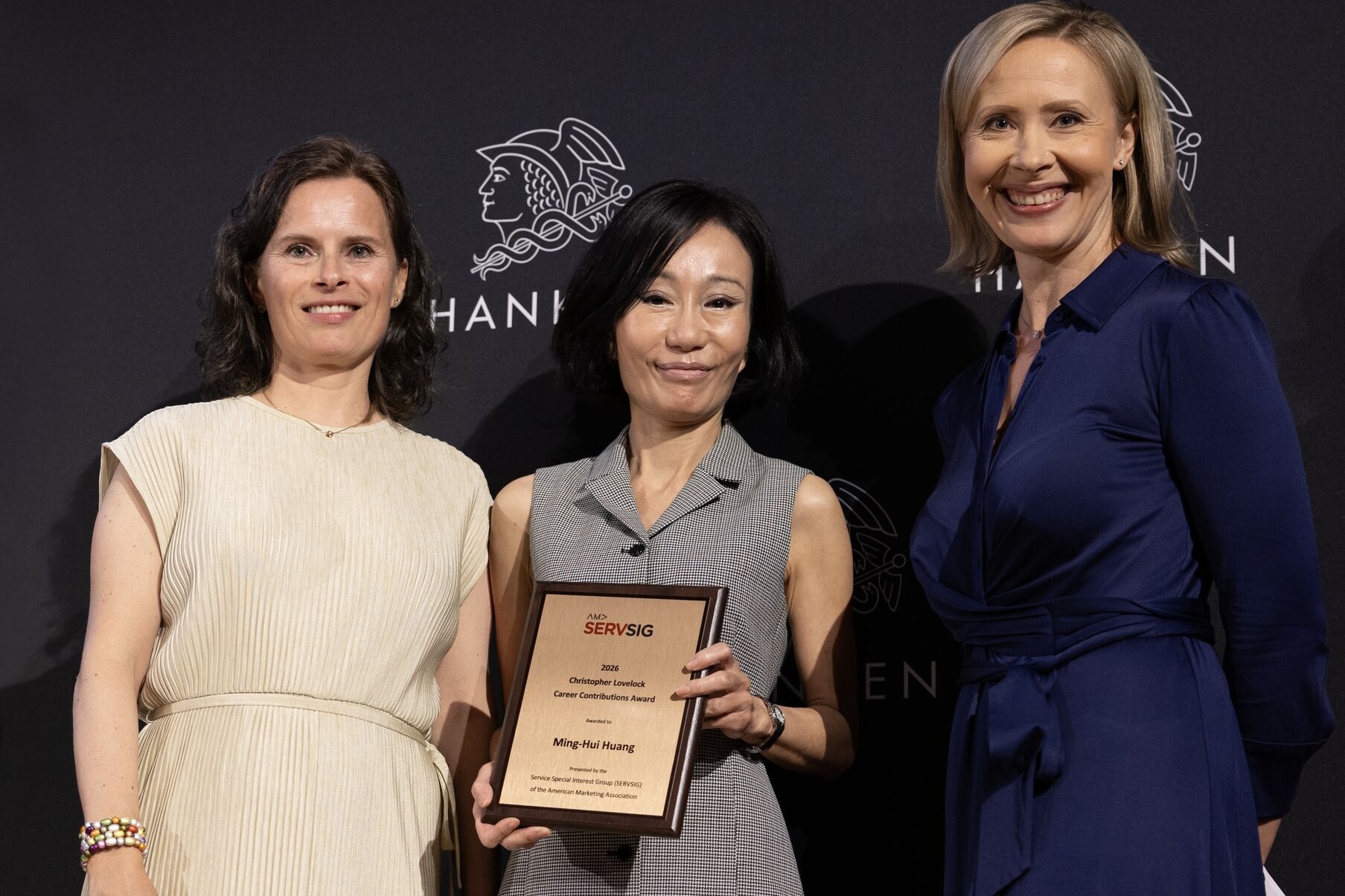
Receiving the 2026 Christopher Lovelock Career Contributions Award was very special to me. I am grateful to SERVSIG, the award committee, and the colleagues who nominated me. Because the nominations are confidential, I cannot thank them by name. But they know who they are, and it means the world to me that they did this.
Preparing the award talk gave me a reason to look back at my research career. When we are busy working on one paper after another, we do not always stop to ask how the different pieces fit together. Looking back, I realized that there has been a fairly clear line through my work: emotion, service, and feeling AI. I began my career by measuring love. Now I am trying to teach machines to feel.
My early research was at the intersection of emotions and relationships. I wanted to understand human emotions and how they affect marketing and consumers. This is reflected in my service research on interactions between people and the feelings created through those interactions. This became even more important as AI began to take over more service tasks.
In my 2018 Journal of Service Research article, “Artificial Intelligence in Service,” I proposed that AI has multiple intelligences. Mechanical AI performs routine tasks. Analytical AI analyzes data, learns, and makes predictions. Intuitive AI predicts the unpredictable. Feeling AI recognizes, understands, and responds to emotions. At the time, intuitive and feeling AI were still quite limited. However, I believed that they would become increasingly important as AI moved from the background of service into direct interaction with customers.
This view led to the idea of the feeling economy. As AI becomes better at thinking, people do not become less important. Instead, the value of human work shifts toward feeling. People need to relate, communicate, empathize, and manage relationships. This is the feeling economy when AI does more of the thinking, people will do more of the feeling.
AI, of course, did not stop at thinking. It is now learning to recognize and respond to emotion. This development led to the 2024 Journal of Marketing article, “The Caring Machine.” In this article, I examined how feeling AI can support customer care through four stages: recognizing emotion, understanding it, managing the response, and building a connection. I am not claiming that machines feel in the same way humans do. The practical question is whether a machine can understand what a person needs and respond in a way that is empathetic, helpful, and caring.
Looking back, I can now see how my service research moved from service productivity to the service revolution, the feeling economy, feeling AI, and the caring machine. The focus also changed along the way. I began by asking how technology could make service more productive without sacrificing customer satisfaction. I am now asking how humans and AI can work together to provide better care. Most recently, I have been studying generative and agentic AI, including how AI can create and act, not just analyze and respond.
The next frontier is the relationship between humans and AI. I believe service research should be the home for studying this relationship because service scholars understand interactions, emotions, relationships, and value creation. The challenge is to build machines that can care while remaining capable, bounded, and responsible.
My advice to young scholars is simple: dream big. You may not know where an idea will eventually take you. I certainly did not expect that studying human feeling would one day lead me to study machines that feel.
The future of service will be felt, not only thought.

Ming-Hui Huang
Distinguished University Professor
National Taiwan University
