
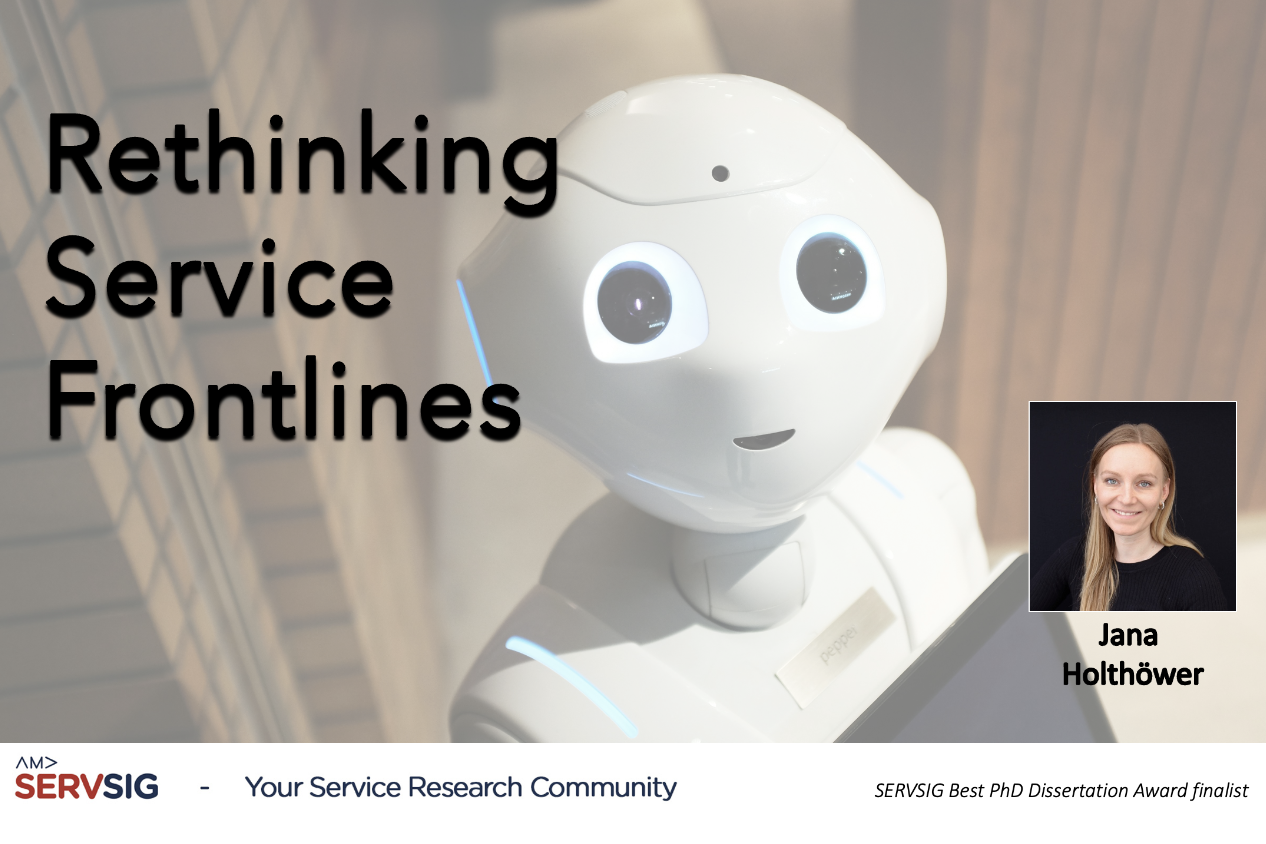
Guest article by Jana Holthöwer, winner of the 2026 SERVSIG Best Dissertation Award.
Service robots are no longer a futuristic curiosity—they are already greeting hotel guests, delivering hospital supplies, and assisting consumers in everyday service encounters. Yet despite their growing presence, one question continues to divide both scholars and practitioners: Do people actually want to be served by robots?
Prior work on AI and robotics in marketing shows that these technologies are typically introduced by taking over specific tasks within broader service processes [1]. Their impact therefore depends less on the technology itself and more on how it is embedded into service interactions. While existing research often highlights consumer hesitation, this view is incomplete. My dissertation takes a more nuanced perspective by asking not whether service robots are good or bad, but when and how they improve service experiences.
In my dissertation, I examine how service robots shape consumer acceptance, satisfaction, and compliance in frontline settings. The findings show that robots do not have a uniform effect. Instead, their impact depends systematically on situation-specific factors (e.g., embarrassment, feedback) and robot-specific factors (e.g., design, accountability) [2].
A first insight is that robots can reduce social discomfort in sensitive service encounters [3]. Situations such as purchasing stigmatized products, receiving corrective feedback, or admitting mistakes are often characterized by concerns about social judgment. Human presence can intensify these concerns whereas robots, by contrast, reduce perceived social judgment. Consumers feel less evaluated by a technology, which increases their willingness to engage. As a result, robots can function as a social buffer, making it easier for consumers to face situations they might otherwise avoid. This is particularly important because avoiding such interactions, especially in domains like healthcare, can have negative long-term consequences for consumer well-being.
A second insight concerns feedback in transformative services, where social interaction and feedback are central to service delivery. In these contexts, improvements in consumer well-being depend critically on how feedback is received. Robot-delivered feedback shapes consumers’ self-concept differently than human-delivered feedback. Negative feedback from a robot is perceived as less threatening and therefore less detrimental to satisfaction. At the same time, positive feedback from robots tends to carry less weight. One way to address this is through peer comparison mechanisms, for example, by benchmarking progress against similar others or highlighting relative performance. These comparisons help make positive feedback more meaningful for how consumers see themselves.
Finally, I examine how service robots influence compliance with advice. Whether consumers follow robot advice depends critically on perceived accountability. When advice is conveyed in a way that connects it to a human social presence—for instance, by signaling that it is given on behalf of a human—consumers are more likely to take it to heart [4]. Importantly, this heightened sense of accountability and the resulting compliance persists over time. Yet, relying on a human service provider as a source of social presence is not always feasible. In such cases, accountability can also be strengthened through social cues embedded in the robot’s advice.
Taken together, these findings shift the conversation. The key question is no longer whether robots should replace humans, but how they should be integrated into service processes. Service robots are not universally preferred but in the right contexts, and with the right design choices, they can meaningfully enhance consumer experiences and well-being.
In short, robots do not need to become more human to succeed. In some cases, their advantage lies precisely in not being human. More broadly, this perspective aligns with recent work that views service frontlines as systems of interaction between consumers, employees, and autonomous technologies, rather than isolated dyads [5]. Understanding these configurations will be central as service systems become increasingly hybrid.
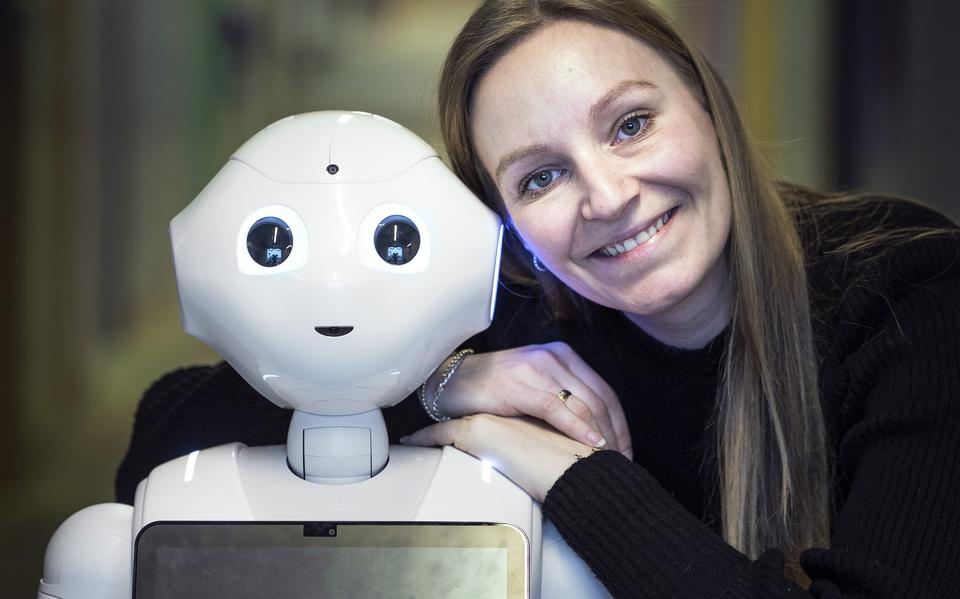
Jana Holthöwer
Assistant Professor in Marketing
Faculty of Economics and Business
University of Groningen
[1] Holthöwer, J., & van Doorn, J. (2021). Artificial intelligence and robotics in marketing. In The digital transformation handbook–From academic research to practical insights. University of Groningen Press
[2] Holthöwer, J. (2024). Robots to the Rescue? Shaping Service Experiences in Healthcare and Beyond
[3] Holthöwer, J., & Van Doorn, J. (2023). Robots do not judge: service robots can alleviate embarrassment in service encounters. Journal of the Academy of Marketing Science, 51(4), 767-784.
[4] Holthöwer, J., van Doorn, J., & Noble, S. M. (2025). Increasing Accountability and Compliance with Robot Advice. Journal of Marketing, 00222429251370268.
[5] Van Doorn, J., Smailhodzic, E., Puntoni, S., Li, J., Schumann, J. H., & Holthöwer, J. (2023). Organizational frontlines in the digital age: The Consumer–Autonomous Technology–Worker (CAW) framework. Journal of Business Research, 164, 114000.
Image: Alex Knight

Congratulations. I found similar evidence in my research projects as well. “Service robots are not universally preferred but in the right contexts, and with the right design choices, they can meaningfully enhance consumer experiences and well-being. In short, robots do not need to become more human to succeed. In some cases, their advantage lies precisely in not being human”