
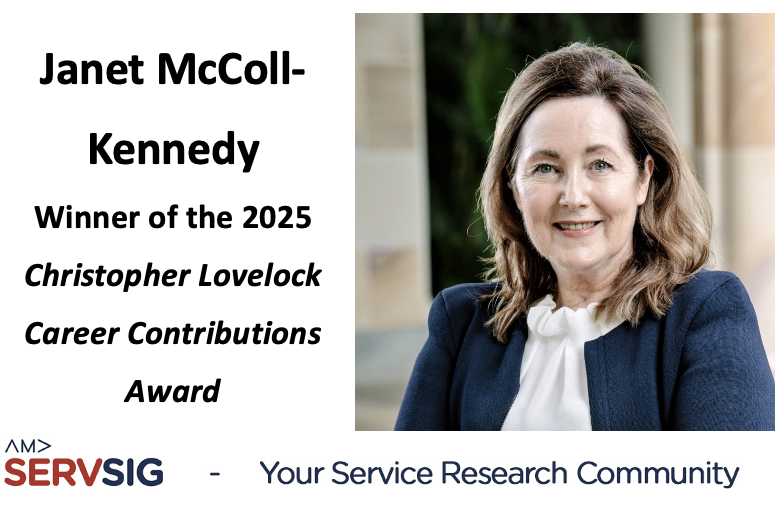
Guest article from Janet McColl-Kennedy, Christopher Lovelock Career Contributions to the Service Disciple Award Recipient 2025.
As the recipient of the 2025 Christopher Lovelock Career Contributions to the Services Discipline Award, I have been asked to write an article for this newsletter. I am delighted to accept and pass on some lessons I have learnt in my career in service research. I trust my reflections and tips for success will assist aspiring researchers.
First, my advice is to identify early on what you would like to be known for in 5 years, 10 years and longer. In other words, what is your “patch”. This was advice I received early in my career and it has stood me in good stead. I am proud to be a “service researcher”. Closely linked to this is to be able to articulate your contributions to the field and importantly to develop a strategic program of research with planned outputs and funding sources.
Let me highlight my three key distinct yet related streams of research: (1) value co-creation, (2) customer rage and (3) customer experience.
1. Regarding value co-creation, I can point to the first empirical study of value co-creation. This multi-year stream of research has resulted in four key articles published in the Journal of Service Research and several international conference presentations and best paper awards. Our first article published in 2012 identified five styles of value co-creation (McColl-Kennedy et al. 2012) and has over 1607 citations (Google Scholar). The second paper in the series highlighted that value co-creation can have halo effects in service (Dagger, Danaher, Sweeney and McColl-Kennedy 2013). The third, Sweeney, Danaher and McColl-Kennedy (2015) focused on the effort involved in co-creating value. In 2024 we published our longitudinal study which investigates value co-creation over time (Danaher, Danaher, Sweeney and McColl-Kennedy 2024). Importantly, this program of research was funded by a competitive grant from the prestigious Australian Research Council (ARC) $116,000 in cash plus in-kind contributions from industry. Our 2012 paper was short listed for the best Journal of Service Research paper.
2. Regarding customer rage, I led the first international study of customer rage investigating differences and similarities in the expression of customer rage in the US, Australia, Thailand and China. This multi-study, multi-year program of research was funded by a $240,000 grant from the ARC. In addition to several international conference presentations, five articles – McColl-Kennedy, Patterson, Smith and Brady (2009); Patterson, McColl-Kennedy, Smith and Lu (2009); Surachartkumtonkun, Patterson and McColl-Kennedy (2013); Surachartkumtonkun, McColl-Kennedy and Patterson (2015) and Patterson, Brady and McColl-Kennedy (2016) were published in the Journal of Service Research, Journal of Retailing and California Management Review. Our 2016 paper was shortlisted for the 2016 Best Journal of Service Research paper.
3. Regarding customer experience, I led our 2019 Journal of Service Research (McColl-Kennedy, Zaki, Lemon, Urmetzer and Neely – highly commended paper and which was a finalist with two other papers for the best 2019 JSR paper. This stream of research involves seven articles Bolton et al. (2018); McColl-Kennedy et al. (2019); Zaki and McColl-Kennedy (2000); Zaki, McColl-Kennedy and Neely (2021); Orsingher et al. (2024); McColl-Kennedy et al. (2026) and Jha, Wright, Singhal, Zhang, Burton and McColl-Kennedy (2025), and an editorial article by Zaki, Gustafsson, McColl-Kennedy and Witell (2026), in addition to several international conference papers.
Ten key lessons:
- Identify your patch – be clear about what research topics you want to be known for. In what ways are the topics connected? Articulate a compelling narrative. It’s helpful to practice your elevator pitch about your work.
- Search out what’s novel. Try to be “first in the field” which should result in a highly cited paper.
- Work on important topics, especially significant problems/challenges. Keep an eye out for articles that identify priority topics, such as Ostrom et al. (2021) and Field et al. (2021).
- Articulate your contributions to theory and practice. Are you making a conceptual contribution? Are you making an empirical contribution? Are you making methodological contributions? Are you making normative contributions?
- Build your research teams that have common values, such as integrity, working to timelines, working collaboratively and with complementary skill sets. Importantly have fun!
- Develop relationships with researchers who bring different skills to your own. Think international. Be willing to travel overseas to conferences and workshops. If possible, take sabbaticals. Spending time at another university opens up potentially new and different ways of doing things as well as providing new opportunities for collaborations.
- Invest in your career. You may need to pay some of the travel and registration costs yourself. Remember this is a long term investment in your career.
- Actively contribute at conferences and workshops. Be present at conferences. Introduce yourself. Actively contribute by asking pertinent questions in sessions, discussing topics with delegates at the lunch, coffee breaks and dinners.
- Keep focused on your research goals.
- Learn to enjoy the process of writing. That is, writing, re-writing, editing, revising and re-submitting. Be resilient. It’s important to look back at your early drafts of your paper and compare them with the final accepted paper. If you look at it objectively, I’m sure you’ll agree that the changes that have been made in the review process have improved your work. Finally, celebrate your successes!
Wishing you every success in your career.

Janet R. McColl-Kennedy
Professor of Marketing, Business School, The University of Queensland
Lead, Innovation Pathways Program, FaBA (Australia’s Food and Beverage Accelerator)
Australian Research Council (ARC) College of Experts Appointed Member
Honorary Visiting Professor and Fellow, Cambridge Service Alliance, University of Cambridge
References
Bolton, R., J.R. McColl-Kennedy, L. Cheung, A.S. Gallan, C. Orsingher, L. Witell, M. Zaki (2018), “Customer Experience Challenges: Bringing Together Digital, Physical and Social Realms”, Journal of Service Management, 29, 5, pp. 776-808.
Dagger, T., P. Danaher, J. Sweeney and J.R. McColl-Kennedy (2013), “Selective Halo Effects Arising From Improving the Interpersonal Skills of Frontline Employees”, Journal of Service Research, 16, 4, pp. 488-502.
Danaher, T., P. Danaher, J. Sweeney and J.R. McColl-Kennedy (2024), “Dynamic Customer Value Cocreation in Healthcare”, Journal of Service Research, 27, 2, 177-193.
Field, J. M., D. Fotheringham, M. Subramony, A Gustafsson, A. L., Ostrom, K.N. Lemon, M. Huang and J.R. McColl-Kennedy (2021), “Service Research Priorities: Designing Sustainable Service Ecosystems”, Journal of Service Research, 24, 4 pp. 462-479.
Jha, G., J. Wright, A. Singhal, Y. Zhang, J. Burton and J.R. McColl-Kennedy (2026), “Addressing Vulnerability in Customer Experience with AI-agents”, Journal of Service Management, accepted in press.
McColl-Kennedy, J. R., P.G. Patterson, A.K. Smith, and M.K. Brady (2009), “Customer Rage Episodes: Emotions, Expressions and Behaviors”, Journal of Retailing, 85, 2, pp. 222-237.
McColl-Kennedy, J.R., S. L. Vargo, T.S. Dagger, J.C. Sweeney and Y. van Kasteren (2012), “Health Care Customer Value Cocreation Practice Styles”, Journal of Service Research, 15, 4, pp. 370-389.
McColl-Kennedy, J.R., M. Zaki, K. Lemon, F. Urmetzer and A. Neely (2019), “Gaining Customer Experience Insights that Matter”, Journal of Service Research, 22, 1, pp.8-26.
McColl-Kennedy, J. R., M. Zaki, T. Andreassen, L. Coote, E. Brea, F. Willer and J. Andrade (2025), “Digital Twins: A Game Changer in Customer Experience”, Special Issue on Service Transformation in Journal of Service Management. https://doi.org/10.1108/JOSM-12-2024-0540
Orsingher, C., J.R. McColl-Kennedy, T. Green, M. Varnfield, M. Zaki, J. Li, K. Butten, J. Titman and D. Hansen (2024), “Mobile Applications (Apps) as Service Provider Actors: Reimagined Roles, Interactions and Impact on the Service Experience”, International Journal of Consumer Studies 48, 2. http://doi.org/10.1111/ijcs.13016
Ostrom, A. L., J.M. Field, D. Fotheringham, M. Subramony, A Gustafsson, K.N. Lemon, M. Huang and J.R. McColl-Kennedy (2021), “Service Research Priorities: Managing and Delivering Service in Turbulent Times”, Journal of Service Research 24, 3, pp. 329-353.
Patterson, P. G., M. K. Brady and J.R. McColl-Kennedy (2016), “Geysers or Bubbling Hot Springs? A Cross-cultural Examination of Customer Rage From Eastern and Western Perspectives”, Journal of Service Research, 19, 3, pp. 243-259.
Patterson, P.G., J.R. McColl-Kennedy, A.K. Smith, and Z. Lu (2009), “Customer Rage: Triggers, Tipping Points, and Take-outs”, California Management Review, 52, 1, pp. 6-28.
Surachartkumtonkun, J., J.R McColl-Kennedy and P.G. Patterson (2015), “Unpacking Customer Rage Elicitation: A Dynamic Model”, Journal of Service Research, 18, 2, pp. 177-192.
Surachartkumtonkun, J., P. G. Patterson and J. R. McColl-Kennedy (2013), “Customer Rage Back-story: Linking Needs-based Cognitive Appraisal to Service Failure Type”, Journal of Retailing, 89, 1, pp. 72-87.
Sweeney, J.C., T.S. Danaher and J.R. McColl-Kennedy (2015), “Customer Effort in Value Cocreation Activities: Improving Quality of Life and Behavioral Intentions of Health Care Customers”, Journal of Service Research, 18, 3, pp. 318-335.
Zaki, M., A. Gustafsson, J. McColl-Kennedy and L. Witell (2026), “What Can Service Research Contribute to Better Understand B2B: Editorial for the Special Issue “Service Research in Business-to-Business Marketing”, Journal of Business Research, April, What can service research contribute to better understand B2B: Editorial for the special issue “Service Research in Business-to-Business Marketing”
Zaki, M., J.R. McColl-Kennedy and A. Neely (2021), “Using AI to Track How Customers Feel – In Real Time”, Harvard Business Review, 4 May 2021 https://hbr.org/2021/05/using-ai-to-track-how-customers-feel-in-real-time
Zaki, M. and J.R. McColl-Kennedy (2020), “Text Mining Analysis Roadmap (TMAR) for Service Research”, Special Issue of Journal of Services Marketing on Qualitative Methods in Service Research, Journal of Services Marketing, 34, 1, pp.30-47.
