
guest article by Mark Rosenbaum
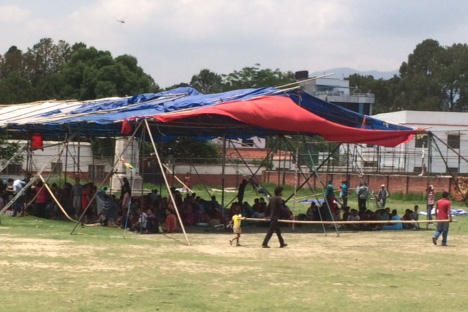
By now, the world has seen the devastation of the April 25 earthquake, as well as its related aftershocks and tremors. Interestingly, journalists tend to cover Nepal’s devastation by highlighting damage done to tangible things, like residential homes, villages, and century-old Hindu and Buddhist relics. We even have photo-journalistic drones flying overhead taking panoramic perspectives of damaged areas. Although photos of devastation service a public interest, few people realize the role that Nepal’s service industries play in both supporting and hindering relief efforts. I should preface that my views of Nepal’s service industries are based upon my residing in Nepal, since January, as a Fulbright Scholar working with at Kathmandu University School of Management
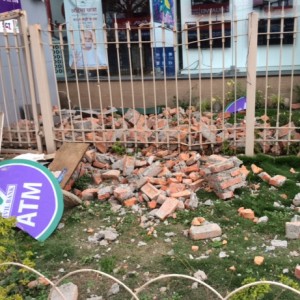 The earthquake on April 25 was a natural disaster, and, most Nepalese service industries, including telecommunications, hospitals, airport, and government services were ill-prepared for this event. That is, Nepalese service organizations lacked contingency plans in the case of a major earthquake. I want to emphasize that the April 25 earthquake was expected. Indeed, when I arrived in the country on January 4, the U.S. Embassy provided me with an earthquake survival kit and told me that a major disaster was imminent in the very near future. Then, the fact that Nepal’s key service industries, including the government, lacked contingency plans for the 4/25 disaster is an appalling lack of judgment. I’ll explain this in more detail.
Although Nepal relies heavily upon tourism for economic development, the country only has one single international airport, which only has one runway. Thus, the airport could not properly handle all of the aid transports that were flying into Kathmandu following the earthquake. Ironically, an Israeli 747, which was carrying a mobile hospital, was denied entry because the runway could not handle the weight of the aircraft and its supplies. How is it possible that the Nepalese government would permit its contact to the international world to be limited to one runway, which cannot even handle proper tonnage?
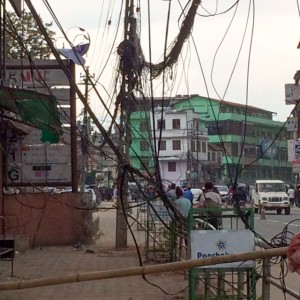 Given that the government lacked contingency plans, rescue teams were lost as to where to provide aid. In fact, a few days after the earthquake, an Indian rescue team stopped me on the street and asked me where they should go to provide help. At first, I was shocked as to why this medical rescue team was asking me for instructions and then I realized that they truly had no idea where to go in the country. I directed the Indian team to the United Nations Headquarters in Kathmandu.
In many cases, Nepal’s roads are not properly maintained and hence they suffer from decay due to mudslides and fallen debris due to mountainous terrain. After the 4/25 earthquake, many roads became impassable because safety nets or barriers to prevent landslides from reaching the road were never installed. Thus, rescue teams could not assess the rural countryside, which suffered the most damage, deaths, and injuries, immediately following the disaster. Where was the contingency plan? Both the United States and India began using helicopters to reach the rural areas; unfortunately, the USA lost a helicopter and its crew trying to reach remote villages.
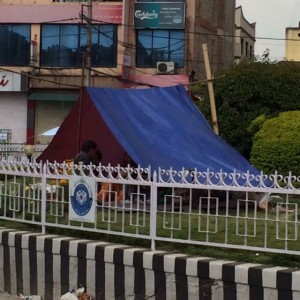 Interestingly, the homes in my neighborhood tended to survive the earthquake because they were built to meet earthquake regulations. Thus, one would think that all structures in Nepal would be built to code; however, this is not the case. Many contemporary structures suffered internal damage due to the earthquake because they were not built to code guidelines. These newer structures tended to be built by Indian real-estate developers who provided bribes to home inspectors to look the other way regarding earthquake codes. Thus, inspectors failed the country in many cases, which resulted in increased number of deaths.
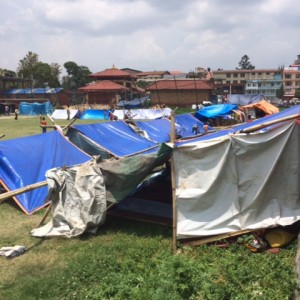 Further, outside of Kathmandu, the government building inspectors overlooked regulations in rural areas. This governmental oversight allowed Nepalese to construct homes out of readily available materials, include brick and mortar, clay, and mud. Or, in another building technique, Nepalese continued to vertically construct their homes upwards by adding levels for their extended families. Because inspectors permitted this before, the upper levels were structurally weak given the base, and during the earthquake, the upper levels toppled, leaving the base levels solid. Given bribery and and overall lackadaisical approach to construction outside of Kathmandu, it is not surprising that many Nepalese built shoddy homes that became their coffins on April 25.
Where does Nepal go from here? Will the country’s service industries learn lessons from this event or will life continue as usual? Will the massive amounts of aid be used to construct new homes that meet earthquake codes, or will weak structures once again be the norm outside of Kathmandu. I don’t have the answers to these questions; however, I have some inclinations.
How can you help Nepal?
First and foremost, I tell everyone to travel here. Despite the situation, the country’s natural beauty is profoundly beautiful. Only 20% of the country was impacted by the earthquake and the country is in desperate need of tourists.
In addition, I encourage you to purchase Nepalese products including coffee, carpets, textiles, and dog treats. Please see sites such as http://www.himalayandogchew.com and http://yetidogchew.com for ways to support Nepal’s export economy.
Service industries are supposed to enhance individuals’ lives and well-being; indeed, this is the purpose of the transformative service research paradigm. To date, I have seen the opposite among Nepal’s service providers; their actions, in many cases, did not promote individual or communal well-being. I hope in the future that the situation changes; however, I’m not entirely sure that it’s possible to do so.
 Mark S. Rosenbaum, Ph.D.
Fulbrighter
Kohl’s Corporation Professor of Retail Marketing
Northern Illinois University
