
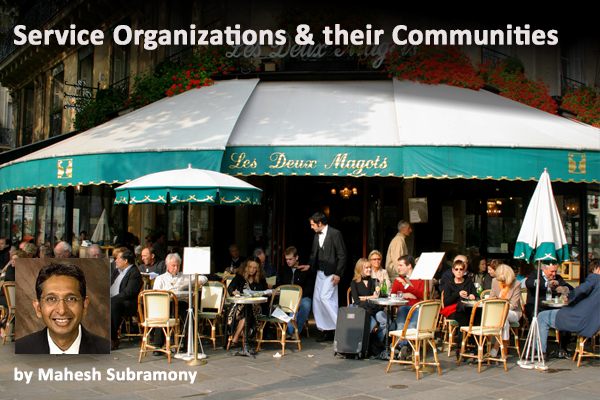
 Guest article by Mahesh Subramony
Imagine sipping a hot beverage in a coffee shop in your town or city. All around you are the sights and sounds of people interacting with each other: students working on a project, friends laughing, couples whispering to each other, an employee and a customer discussing the previous night’s football game. Here or elsewhere, you might also notice subtle hints of racial, cultural, or gender bias in the interactions between employees and customers. More broadly, you might know that the chain to which this coffee shop belongs, has played a significant role in uplifting your local community during the recent economic downtown.
Each of the above cases highlights the importance of considering community in service research. Also, each provides a unique perspective or window into how communities and service organizations interact. Specifically, (a) customers as community members utilize the organization to create social value, (b) the community context (and the diversity therein) spills over into interactions between organizations and their customers, and (c) organizations and communities together create social value. My paper, “Service Organizations and their Communities”, explores these three perspectives utilizing a wide variety of research studies conducted in management, marketing, and other social sciences.
The motivation for this paper was, quite simply, to address the underrepresentation of community within services and management literature. For instance, less than 3% of the studies included in a recent review of services management included community effects (Subramony & Pugh, 2015), and only one study examining community effects was included in a comprehensive review of organizational corporate social responsibility (CSR) (Aguinis & Glavas, 2012). I found this gap surprising. It was almost as if theorists and researchers believed that the only interaction worth studying with respect to the aforementioned coffee shop (or for that matter in banks, grocery stores, restaurants, libraries, consulting firms, travel agencies) was the commercial transaction between the employee and the customer. The customer walks into the shop, is greeted, orders, pays, and leaves. All interactions within the store, employee and customer biases, contextual effects, creation of social or transformative value – all these are just noise!
I systematically reviewed 40 articles published in 20 volumes of 8 top management journals and supplemented this review with papers related to third places, servicescapes, transformative services, brand/consumption communities, and many other related areas within sociology and psychology. This review led to the identification of three perspectives – service organizations as recipients of institutional and demographic influences from their host communities, customers as community members utilizing service establishments as resources for the creation and maintenance of social relations, and service organizations and communities engaging in the joint-creation of value. I discuss each of these perspectives in my article, and explore their implications for various streams of management literature.
I would like to take this opportunity to encourage service researchers to read this article and consider different ways in which they can incorporate community into their own conceptual and empirical work. Also, in the spirit of community engagement, I hope that you will reach across disciplinary boundaries to engage with your management and social science colleagues to design and implement studies in this realm. Finally, please reach out to me directly (msubramony@niu.edu) to chat about this fascinating area of study.
More information you find in the article here
 Mahesh Subramony is Associate Professor of Management at Northern Illinois University and Director at the Centerof Human Capital Management.
