
Guest article by Roland Rust, recipient of the Grönroos Award 2026.
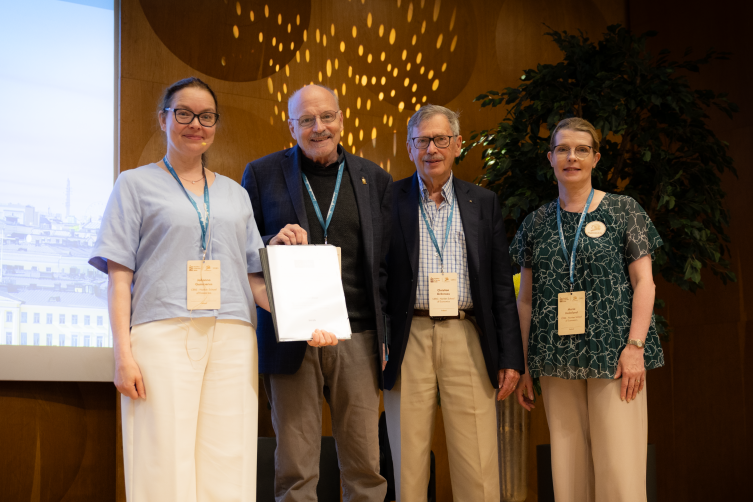
It is my great honor to win the Grönroos Award, named for the pioneering Finnish service researcher, Christian Grönroos. The photo shows me receiving the award from Christian. The others in the photo are Hanken head of marketing Maria Holmlund and Professor Johanna Gummerus. The award is especially meaningful, given the leading role the Nordic countries played in establishing the field of service marketing.
Because most of my current work relates to AI in service, I will take some time here to say what I think about that field, and where things are going to go in the future. I must give tremendous credit to my very frequent co-author, Ming-Hui Huang, who has helped me stay motivated over the latter years of my career. Ming-Hui is a brilliant scholar who spans IS and Marketing, and who recently very deservedly won the Christopher Lovelock Award for career contributions to service research.
We see AI as involving multiple intelligences (thanks to Ming-Hui for this insight). Our 2018 JSR article, “Artificial Intelligence in Service” (Huang and Rust 2018), which has now been cited more than 6400 times, proposed that intelligence can be grouped into mechanical, thinking, and feeling intelligence. Mechanical intelligence involves only repetitive tasks, and was all that most AI researchers formerly thought was possible. However, the advance of generative AI eventually revealed that thinking intelligence (both analytical and intuitive) was also possible. This was discovered when ChatGPT was seen writing computer code. It was a surprise, even to the developers at OpenAI, that their product was able to do that. This is because they did not program ChatGPT to be able to code. It figured it out on its own, as an emergent process. Today, many thinking tasks are taken on by AI. What is new to many people is that the emergent property of AI should imply that AI can also successfully assume creative tasks, or even feeling tasks. Our 2024 JM article, “The Caring Machine: Feeling AI for Customer Care” (Huang and Rust 2024), shows what is necessary to make AI exhibit empathy, understand the customer’s feelings, and respond in an emotionally appropriate way.
Where is AI going in the future? Ming-Hui refers to me as “the prophet of doom,” because I believe that AI will soon be smarter than humans in every way. The argument to the contrary is called “human exceptionalism.” The idea is that there are many things that only humans can do. Originally, the idea of human exceptionalism was that there are things that humans can do that “animals” (Author’s Note: the reference should instead be to other animals). However, the list of human things that other animals can’t do has been shrinking over the years, with the scientific consensus being that most of the higher animals (including birds) also have consciousness. I recently saw a photo of a cow using a long stick to scratch its own back (so much for “animals” not using tools!). The same tired human exceptionalism arguments are now being trotted out to use against AI, and once again the list of human-only behavior is getting smaller and smaller. We need to realize that humans aren’t as special as we thought we were.
Where does that leave us? In my “prophet of doom” mode, I can confidently assert that AI will get as smart as us, then smarter than us, and then much smarter than us. At that point, we will be to AI what ants are to us. We can either be very proud of our super-smart progeny, who will probably take over the world, or we can be Luddites and try to stop technological progress. My very confident prediction is that regulating AI will not work, because we do not have one world government, and some countries (e.g., China) will not permit themselves to be regulated by others. Essentially, we have a prisoner’s dilemma game, and the equilibrium strategy is likely to be “defect-defect,” with no serious regulation being possible. In other words, it will soon be AI’s world, and humans need to figure out how to co-exist with a super-intelligent competitor. That will be a challenge, for sure.

Roland T. Rust
Distinguished University Professor and David Bruce Smith Chair in Marketing
Executive Director, Center for Excellence in Service
University of Maryland
