
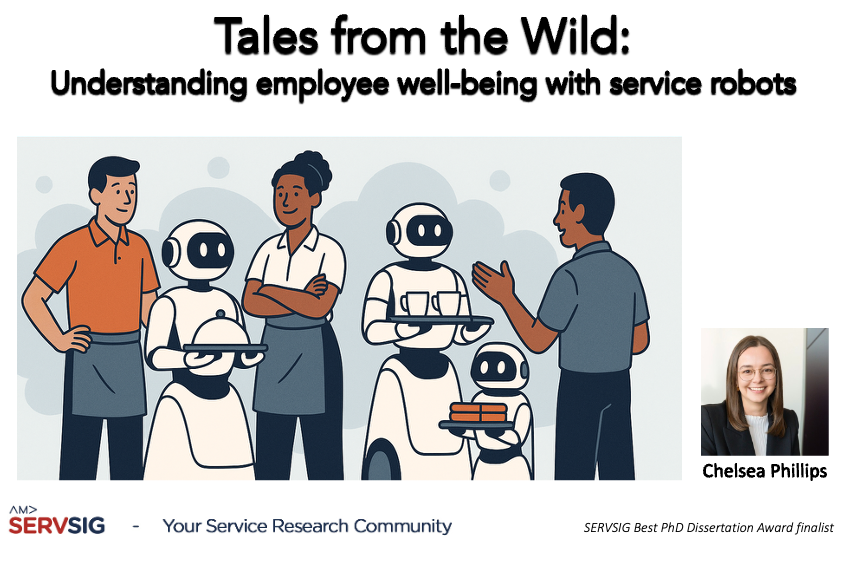
Guest article by Chelsea Phillips, finalist of the 2025 SERVSIG Best Dissertation Award.
We are experiencing a new age, one where service robots are no longer a thing of science fiction. While operating in background manufacturing processes for decades, we are now able to meet and interact with robots in our daily lives. Service robots can lend organisations a ‘helping hand’ by providing a (de)scalable workforce, an attractive proposition in light of acute and enduring staff shortages [1]. The growing adoption of service robots by organisations has allowed service robot research to expand beyond lab studies and hypothetical scenario-based methods. Now we can step “into the wild” and embrace understanding the real world and lived human experiences.
“Stepping into the wild” refers to experiencing service robots that are operating in live service environments, having successfully transitioned from prior technological development stages. Within my PhD, with the Maastricht Center for Robots I embraced a long-standing industry partnership with Dadawan, a fast-casual dining restaurant chain in the Netherlands that has implemented waiter robots in their locations since 2020. Having previously identified that frontline employees (FLEs) experience the most diverse well-being impacts within the human service triad due to service robot introduction [2], I set out to understand how FLEs experience these impacts and what they do to overcome them.
Challenges in FLE-robot collaboration
As identified in the Robotic-Human Service Trilemma [2], literature has posited the challenges human actors face upon the introduction of service robots. In particular, within the relationship between the FLE and customer, FLEs experience the most diverse well-being impacts, termed as the Intrusion challenge [2]. As the name implies, service robots intrude upon the long-standing relationship between the FLE and customer. We identified that FLEs experience an intertwined well-being impact whereby the reduction in social interaction (social well-being [3]) affects their sense of fulfilment in their job (purpose well-being [3]). However, leveraging literature that largely uses simulations and laboratory research of anticipated experiences rather than field or observational studies can only reflect research that is rather than research that should be. This signals the need for research to adopt methods of observing service robots “in the wild” [2].
FLEs are masters of their own well-being
By stepping “into the wild,” we now realise that, yes, service robots do introduce well-being challenges for FLEs. However, FLEs also use the same service robots to overcome these well-being challenges by using task allocation strategies. When presented with a situation that may threaten their well-being, for example an agitated customer, they either perform the task themselves, defer to a colleague, or defer the task to the service robot. Interviewed serving staff commonly cited that they deal with an agitated customer by using the service robot to avoid them entirely, thereby using their reduced connection with customers to their advantage. What this means is that the introduction of service robots creates a FLE well-being paradox, where service robots may introduce negative well-being impact, yet service robots can also be used to address their impacted FLE well-being.
Service robots provide augmentative functions for FLEs
In my PhD, I leveraged field studies in both hospitality and aged care settings, and ascertained that both contexts involved FLEs leveraging task allocation strategies of service robots to address impacted well-being [5]. This is apparent via three augmentative functions. First, service robots can provide a deflecting functionfor FLEs to use where FLEs are able to avoid a customer situation that would otherwise impact their well-being. Second, service robots provide a restorative function for FLEs where service robots can facilitate the conditions necessary for FLEs to rejuvenate their well-being. And third, service robots provide an unburdening function where service robots are a direct resource that can address a specific job demand by performing the task directly.
As demonstrated by these findings, service robot research has reached an exciting milestone, one wherein industry collaboration with service robot-enabled organisations is now possible.
Welcome to the wild!

Chelsea Phillips
Societal Impact Postdoctoral Researcher, Australian Business Deans Council (ABDC)
Visiting Fellow at UNSW Business School
- Phillips, C., Becker, M., Odekerken-Schröder, G., & Mahr, D. (2024). Introducing the Service Robot Innovation Canvas. In The Impact of Digitalization on Current Marketing Strategies (Marketing & Technology: New Horizons and Challenges) (Matosas-Ló, pp. 97–115). Emerald Publishing Limited.
- Phillips, C., Russell–Bennett, R., Odekerken-Schröder, G., Mahr, D., & Letheren, K. (2023). The Robotic-Human Service Trilemma: the challenges for well-being within the human service triad. Journal of Service Management, 34(4), 770–805.
- Gallup. (2008). How Does the Gallup-Sharecare Well-Being Index Work? Gallup.
- Phillips, C., Odekerken-Schröder, G., Russell-Bennett, R., Steins, M., Mahr, D., & Letheren, K. (2025). Service robot–employee task allocation strategies: well-being within the intrusion challenge. Journal of Service Management, ahead-of-print.
- Phillips, C. (2024). Service Robots in the Wild: The Impact of the Robotic-Human Intrusion Challenge on FLE well-being
