
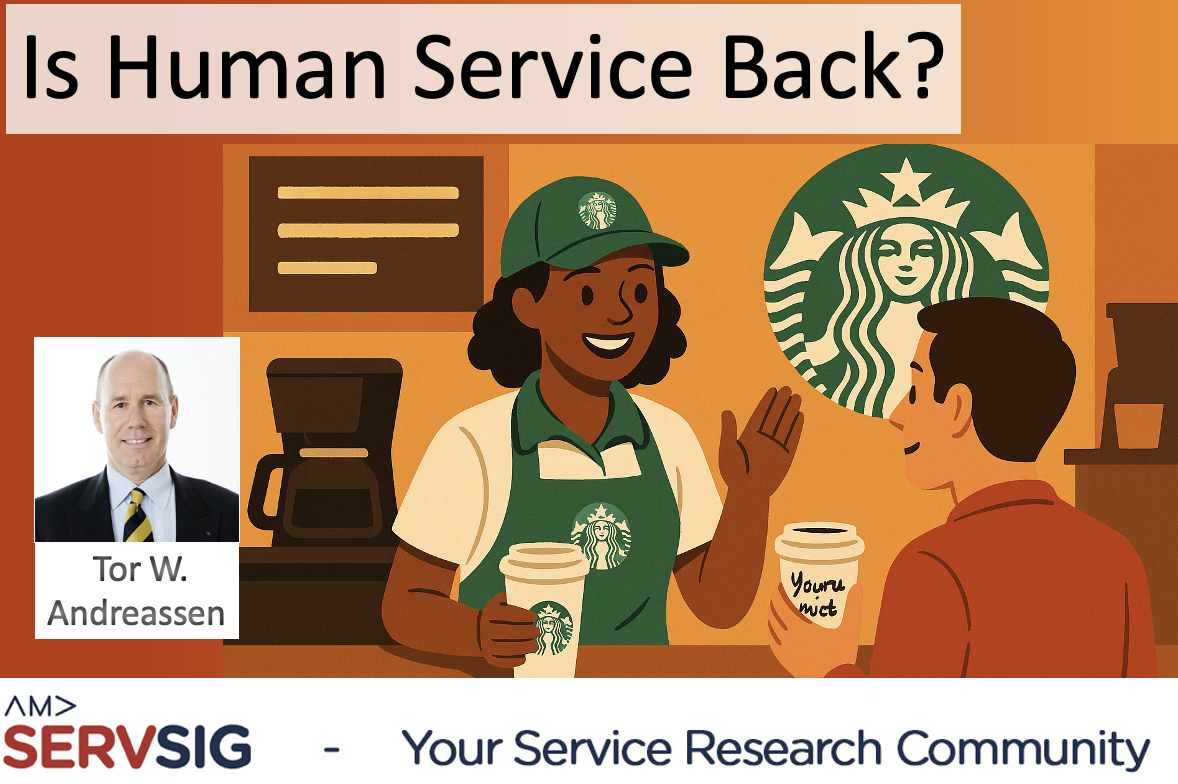
Guest article by Tor W. Andreassen. If you are also interested in the field of company innovativeness, please consider submitting to the upcoming special issue in the Journal of Service Management (JOSM).
As digital interfaces and self-service kiosks reshape customer interactions, Starbucks’ recent overhaul of barista training offers a compelling case study in the resurgence of human-centric service delivery.
As detailed in a Wall Street Journal article (Has Your Starbucks Barista Been Acting Especially Friendly Lately? Here’s Why.), the coffee chain is instructing employees to prioritize eye contact, warm greetings (“Welcome to Starbucks”), personalized compliments (e.g., “Your Caramel Macchiato looks so good—it’s one of my favorites”), and handwritten notes on cups, all while ensuring drinks are prepared in under four minutes. This initiative, aimed at reversing sales declines, underscores a potential shift: Is “human service”—characterized by relational warmth and empathy—making a comeback amid technological saturation?
Empirical evidence from 2025 service research suggests a nuanced affirmative. While automation continues to proliferate, with Gartner projecting 80% of customer service organizations adopting generative AI by year’s end, customer satisfaction metrics reveal limitations. Forrester’s customer experience indices have dipped to historic lows, attributed to over-reliance on AI that erodes trust and authenticity. Concurrently, surveys indicate 75% of consumers favor “authentic connections” for complex interactions, echoing Naisbitt’s (1982) “high tech, high touch” paradigm in contemporary contexts. This pendulum swing is not a rejection of technology but a hybridization, where AI handles routine tasks, liberating human agents for emotional labor.
Explanations for this trend span psychological, economic, and societal domains. Psychologically, post-pandemic isolation has amplified needs for social surrogacy, with Gen Z paradoxically demanding AI speed yet craving human empathy for nuanced issues (60% preference split). Economically, automation’s diminishing returns—evidenced by 5-10x higher churn costs from impersonal experiences—prompt firms to invest in human-augmented models. Societally, digital fatigue and regulatory emphases on AI transparency (e.g., EU AI Act) foster demands for “radical authenticity,” where technology amplifies rather than supplants human narratives.
Starbucks is emblematic but not isolated, with several sectors illustrating a move toward the “human way.” In aviation, Delta Air Lines has expanded frontline roles by adding 5,000 employees focused on empathetic handling of disruptions, contributing to top J.D. Power customer satisfaction rankings. In retail, luxury brand Coach equips associates with clienteling apps that provide customer histories, enabling personalized in-store interactions and doubling conversion rates compared to generic digital approaches.
Hospitality examples abound: Hilton and Marriott leverage AI for seamless check-ins while reallocating staff to high-touch concierge services, resulting in 30% gains in guest satisfaction metrics. In healthcare retail, chains like CVS integrate robotic inventory systems to free pharmacists for patient counseling, revitalizing trust in advisory roles amid automation backlash. Banking sectors, such as community lenders, combine digital tools with tailored outreach to retain small businesses, while contact centers follow McKinsey recommendations for balanced human-AI integrations to enhance efficiency and loyalty. These instances align with Journal of Service Research findings on relational personalization as a key loyalty mediator in AI-driven environments.
For the SERVSIG community, this resurgence invites scholarly inquiry: How might we adapt «the old and the new» frameworks to quantify “touch equity” in hybrid services? As service researchers, we must explore what is the «right» balance between hight technological touch and high human touch and how does this ratio change as a function of context like culture, type of technology and service, and customer segments like age, gender, and expertise, and job to be done, i.e., why do customers decide to interact with the patronage.

Tor W. Andreassen
Professor of Innovation at NHH Norwegian School of Economics
Honorary visiting professor and fellow at IfM, University of Cambridge.

If you are also interested in the field of company innovativeness, we would like you to consider submitting to the upcoming special issue in the Journal of Service Management (JOSM). More information here.
