
Best Paper of the Year Award 2016
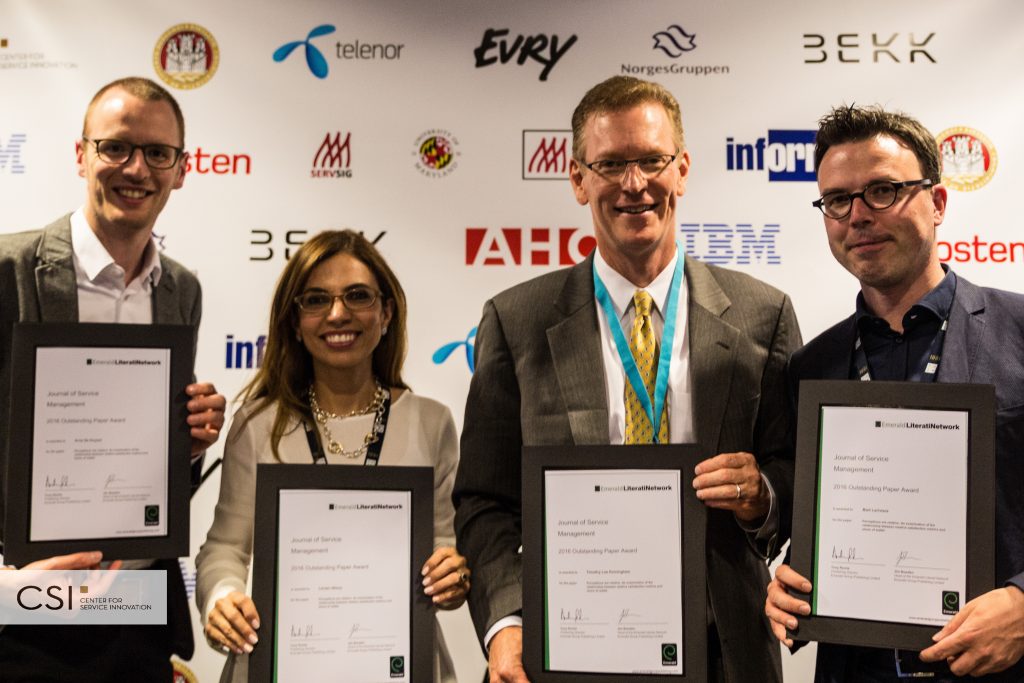
Timothy Keiningham, Bruce Cooil, Edward Malthouse, Alexander Buoye, Lerzan Aksoy, Arne De Keyser and Bart Lariviere.
“Perceptions are relative: an examination of the relationship between relative satisfaction metrics and share of wallet. (Vol.26 Issue 1.)”
Abstract:
Purpose
There is general agreement among researchers and practitioners that satisfaction is relative to competitive alternatives. Nonetheless, researchers and managers have not treated satisfaction as a relative construct. The result has been weak relationships between satisfaction and share of wallet in the literature, and challenges by managers as to whether satisfaction is a useful predictor of customer behavior and business outcomes. The purpose of this paper is to explore the best approach for linking satisfaction to share of wallet.
Design/methodology/approach
Using data from 79,543 consumers who provided 258,743 observations regarding the brands that they use (over 650 brands) covering 20 industries from 15 countries, various models such as the Wallet Allocation Rule (WAR), Zipf-AE, and Zipf-PM, truncated geometric model, generalization of the WAR and hierarchical regression models are compared to each other.
Findings
The results indicate that the relationship between satisfaction and share of wallet is primarily driven by the relative fulfillment customers perceive from the various brands that they use (as gauged by their relative ranked satisfaction level), and not the absolute level of satisfaction.
Practical implications
The findings provide practical insight into several easy-to-use approaches that researchers and managers can apply to improve the strength of the relationship between satisfaction and share of wallet.
Originality/value
This research provides support to the small number of studies that point to the superiority of using relative metrics, and encourages the adoption of relative satisfaction metrics by the academic community.
Link: http://www.emeraldinsight.com/doi/full/10.1108
Highly Commended Awards 2016
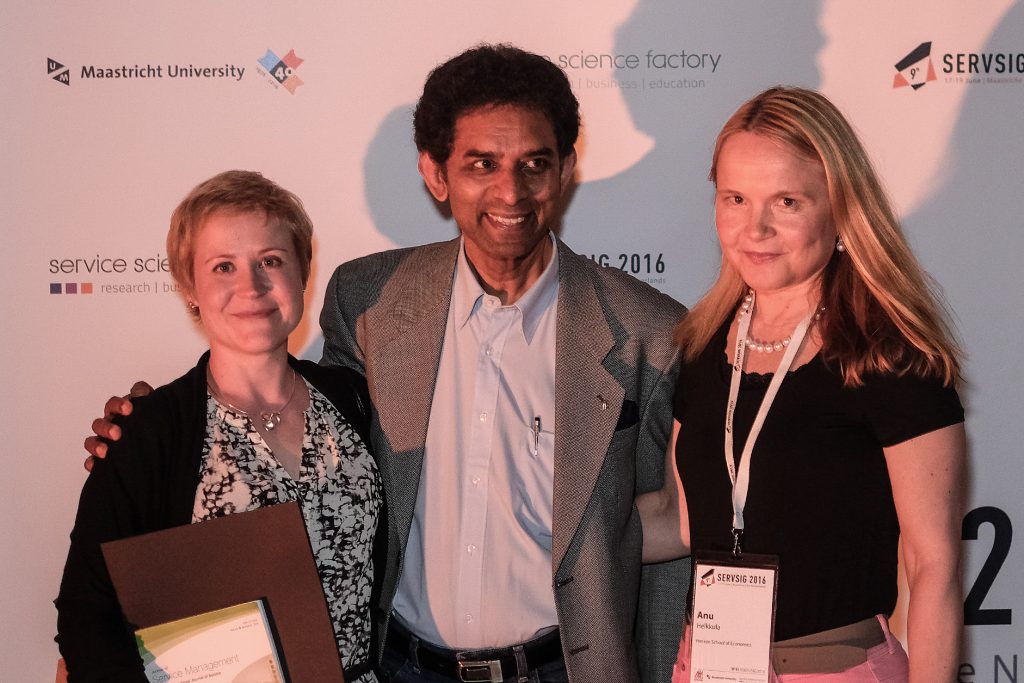
Elina Jaakkola, Anu Heikkula, Leena Aarikka-Stenroos
“Service Experience co-creation: conceptualization, implications, and future research directions. (Vol.26 Issue 2)”
Abstract:
Purpose
The collective, interactive aspects of service experience are increasingly evident in contemporary research and practice, but no integrative analysis of this phenomenon has been conducted until now. The purpose of this paper is to conceptualize service experience co-creation and examines its implications for research and practice.
Design/methodology/approach
To map the multi-approach research area of service experience co-creation, the study draws on literature in the fields of service management, service-dominant logic and service logic, consumer culture theory, and service innovation and design, together with invited commentaries by prominent scholars.
Findings
A conceptualization is developed for “service experience co-creation,” and multiple dimensions of the concept are identified. It is postulated that service experience co-creation has wider marketing implications, in terms of understanding experiential value creation and foundational sociality in contemporary markets, as well as in the renewal of marketing methods and measures.
Research limitations/implications
The authors call for cross-field research on service experience, extending current contextual and methodological reach. Researchers are urged to study the implications of increasing social interaction for service experience co-creation, and to assist managers in coping with and leveraging the phenomenon.
Practical implications
For practitioners, this analysis demonstrates the complexity of service experience co-creation and provides insights on the aspects they should monitor and facilitate.
Originality/value
As the first integrative analysis and conceptualization of service experience co-creation, this paper advances current understanding on the topic, argues for its wider relevance, and paves the way for its future development.
Link: http://www.emeraldinsight.com/doi/abs/10.1108/JOSM-12-2014-0323
Highly Commended Awards 2016
Janet McColl-Kennedy, Paul Patterson, Michael Brady, Lilliemay Cheung and Doan Nguyen.
“To give or not to give professional services to non-paying clients: professionals’ giving backstory. (Vol. 26 Issue 3)”
Abstract:
Purpose
The purpose of this paper is to explicate professionals’ giving backstory, identifying what motivates and hinders professionals’ undertaking of pro bono service activities. Examples are provided of different pro bono giving styles, as professionals struggle to resolve inter-institutional tensions, thus addressing this little understood yet vital form of giving, and meeting an important research priority.
Design/methodology/approach
Using a discovery-oriented grounded theory approach, this paper draws on narratives from interviews with 31 professionals to explicate, from the professional’s point of view, the backstory of pro bono service.
Findings
The authors provide an integrative institutional logics-based framework for understanding the backstory to professionals’ giving. Three distinct pro bono giving styles are revealed: first, an individual logic (self-centric), an “I” logic; second, an organizational logic (organization-centric), “We” logic; and third, a societal “All” logic (where the greater good to society in general is the dominant logic). The paper concludes with recommendations for how professionals and professional service firms (PSFs) can better align their pro bono giving styles with non-paying not-for-profit clients for multi-party benefit.
Originality/value
The originality of this research lies in addressing an important yet little understood form of giving through delving into the backstory to pro bono service. First, the paper theorizes the characteristics of a formerly unarticulated form of giving, distinguishing it from individual-to-individual close consumer gifting, individual to organizational charitable giving, sponsorship, and volunteering. Second, the different inter-institutional logics of pro bono giving are identified, with three main pro bono giving styles uncovered. Third, the authors link professional services theory, theoretical perspectives from giving, and institutional logics theory to develop an integrated framework to explain service professionals’ pro bono activities. Furthermore, a compelling agenda for future research is provided to guide future work.
Link:http://www.emeraldinsight.com/doi/abs/10.1108/JOSM-07-2014-0194
Highly Commended Awards 2016
Wafa Hammedi, Jay Kandampully, Tingting (Christina) Zhang and
Lucille Bouquiaux
“Online customer engagement: Creating social environment through brand community constellations (Vol.26 Issue 5)”
Abstract:
Purpose
The emergence and success of online brand communities in the marketplace have attracted considerable interest; this study seeks to determine the conditions in which people create social environments by investigating the drivers of connections to a focal online brand community and other brand communities. The purpose of this paper is to investigate the composition of multi-community networks, focussing on the density and centrality of brand communities.
Design/methodology/approach
On the basis of insights from prior literature, the proposed model examines customers’ social relationships with multiple brand communities. A survey of 290 participants spans eight brand communities. The modeling process used structural equation modeling; the analysis of the social relationship among brand communities relied on an ego network approach.
Findings
Two drivers prompt connections to other online brand communities. First, personal identification with a core brand community enhances connections to other communities. Second, some core brand members choose a functionality-driven approach in creating social environments.
Practical implications
For marketers, this study highlights the importance of positioning the brand community as part of a social environment. To strengthen customer-brand relationships, marketers should focus on community members’ multiple memberships.
Originality/value
This paper extends understanding of online brand community members’ motivations to participate in a focal brand community. It also explains the creation of a social environment, through a careful consideration of participation in different brand communities and their relationships.
Link:http://www.emeraldinsight.com/doi/abs/10.1108/JOSM-11-2014-0295
Best Reviewer Awards
Yves Van Vaerenbergh
University of Leuven, Belgium
Yves Van Vaerenbergh: yves.vanvaerenbergh@kuleuven.be
Tracy Meyer
University of North Carolina, Wilmington, USA
Meyer, Tracy : meyert@uncw.edu
