

Service Research is a fast growing discipline. To support its growth, SERVSIG aims to bring together service scholars from across the globe to foster collaborations and discuss our future. While SERVSIG aims to support every service researcher, we have developed a particular interest in the young scholars of our community. Specifically, two of our yearly events focus on the training of our youngest research members: Let’s Talk About Service (LTAS) and the SERVSIG Doctoral Consortium (DC).
While both have been very successful in the past, these events have recently undergone a transformation to better serve our community. From now on, based on feedback of previous participants and some of the leading service scholars, LTAS and the consortium will act as complementary research events. The overarching goal may be formulated as: providing guidance to young scholars in developing their research and careers!
Below, we discuss the positioning and aims of both initiatives.
Table: Summarizing the positioning and aims of two initiatives for young scholars, under the SERVSIG umbrella
| NAME:
DC The AMA SERVSIG Doctoral Consortium (DC) |
NAME:
LTAS Workshop The Let’s Talk About Service Workshop, empowered by AMA SERVSIG |
| TARGET AUDIENCE:
Doctoral Students and Young Researchers in the field of Service Research |
|
| AIMS:
(1) Tailored advice on ongoing doctoral research during break-out sessions (2) General advice on 3 themes: managing career, conducting research, and impact through teaching and service |
AIMS:
(1) Intensive workshop on an “emerging” topic and/or methodology; which varies annually (2) Stimulate new research by making small groups, linking people and assigning mentors |
| WHEN & WHERE:
– Annually |
WHEN & WHERE:
– Annually |
As a result, each year there will be 2 distinct events for the younger scholars in our community: one in Europe and one in the US, nicely spread in the Spring and Fall Semester of each year.
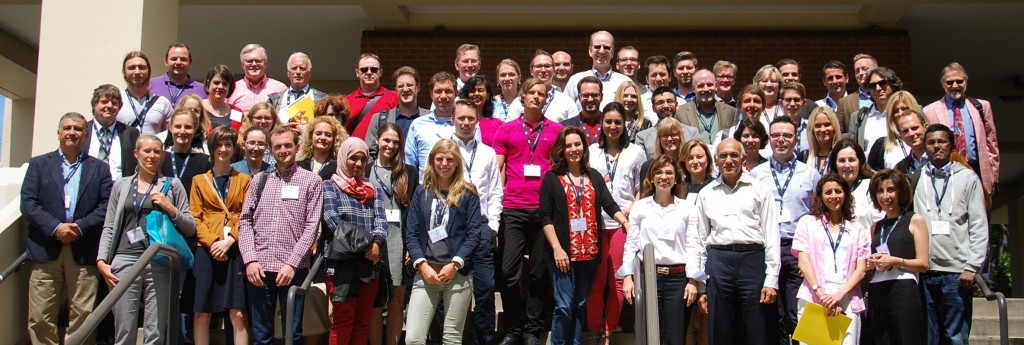
DC in San Jose 2015
SERVSIG Doctoral Consortium (DC)
 The SERVSIG Doctoral Consortium (DC), preceding the annual Frontiers in Service Conference underwent some changes. Based on the answers to the open questions of the 2014 DC participants in Miami, we changed the format. During this year’s edition at San Jose State University (2015), eight small groups of 3 to 4 doctoral students with similar research topics were introduced to each other and linked to both younger (e.g., assistant professors or postdoc fellows) and more senior faculty (leading scholars). They discussed their PhD proposal and/or doctoral studies and received valuable guidance on how to develop their ideas, which theories and methodologies to use, how to position their research, etc. Compared to prior editions, we also intensified the break-out sessions by making it 2 hours instead of 30 minutes. This new format was appreciated since 65% of the participants who answered to the follow-up survey, and who could compare the different formats, evaluated the new format as “much better”, whereas the remaining ones perceived it as “better”.
With this new positioning, the aim of the DC is twofold:
(1) give feedback on planned or ongoing research to doctoral students during the break-out sessions;
(2) give general advice on managing a career, publishing research, and creating impact through teaching by means of 3 sessions in which senior faculty share their insights and own experiences.
For more information on the DC:

LTAS in Ghent 2014
Let’s Talk About Service (LTAS)
 In contrast, Let’s Talk About Service (LTAS) is a two-day annual workshop with the objective of introducing young scholars to the service research world. Every year, one emerging topic takes the centre stage. This topic can be a methodology or be more conceptual in nature, or both. For instance, Rob Kozinets gave a workshop on netnography in 2013, whereas the 2014 edition featured presentations from multiple leading faculty and journal editors of the service community. This edition led to multiple groups of young scholars doing collaborative research under the guidance of experienced mentors.
The 2015 theme of LTAS, “Research Priorities: How to make them happen?” was a logical choice given the recent priorities article published in the Journal of Service Research (Vol 18, No. 2). Thought leaders and co-authors of the priorities article will share detailed insights and knowledge about the potential future research areas. And interestingly, new research will be kicked-off since the doctoral students will have the unique opportunity to elaborate on several collaborative research projects with senior researchers and thought leaders. The participants will be divided into small groups and asked to work on one of the research priorities assigned to them according to their research interests. Finally, Dwayne Gremler will give a method seminar on the Critical Incident Technique in service research.
In sum, the positioning of LTAS is complementary to the DC, and its aim is twofold:
(1) introducing young scholars to an “emerging” topic and/or methodology by means of a 2/3 days workshop;
(2) stimulating joint and new research collaboration by kicking-off and assigning mentors to various research teams.
For more information on the next LTAS edition in Namur:
http://www.servsig.org/wordpress/2015/08/4th-lets-talk-about-service-workshop-in-namur/
Besides a complementary positioning, they also harmonize in terms of timing and place. The doctoral consortium precedes the annual Frontiers in Service Conference, and hence takes place around June/July in the city that hosts the conference, implying that every 3th year (2016, 2019, 2022, …) the DC will be held in a non-US country. The 2016 consortium will take place in Bergen (Norway). LTAS generally takes place in November-December. The 2015 edition takes place in Namur (hosted by the University of Namur). In 2016, the first U.S.-edition will take place in New York (hosted by Fordham University).
As a result, each year there will be 2 distinct (See Table) events for the younger scholars in our community; one in Europe and one in the US, nicely spread in the Spring and Fall Semester of each year.
Hope to see you at the next LTAS in Namur

